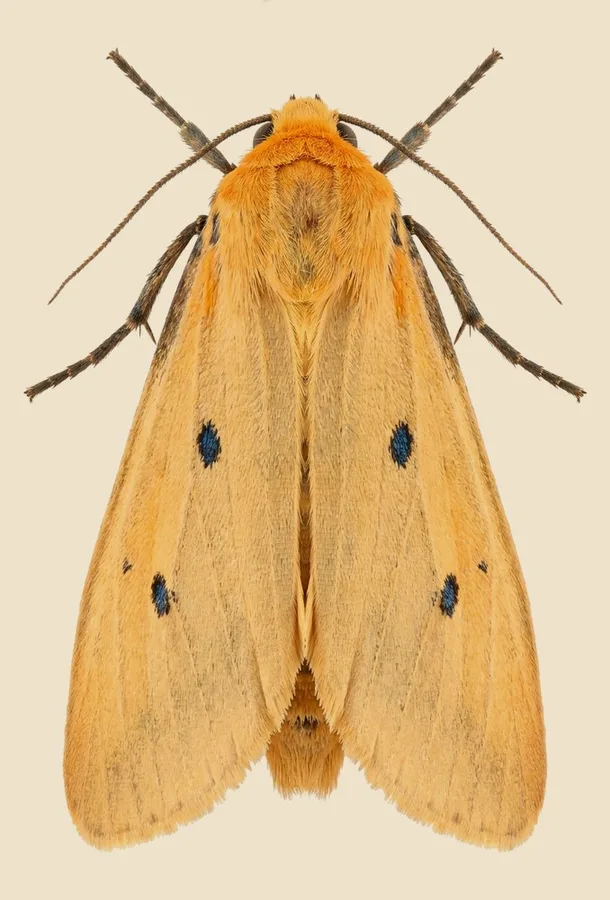
Four-spotted footman
Only females of this moth show the four dark spots that give it its name, and the fold of the wings at rest hides one, leaving three visible.
| Where | Broadleaved woodland and wooded coastal scrub |
|---|---|
| Size | 35 to 55 mm wingspan |
| When | June to October |
The Four-spotted Footman is the largest footman moth found in Europe. Males are plain grey with a narrow yellow leading edge to the forewing, while females are yellow with two dark blue-black spots on each forewing, together appearing as four spots when the wings are spread.
Caterpillars feed on lichens and algae growing on the bark of oaks and other broadleaved trees, and the moth flies from June to October in woodland and along wooded coasts. Adults come readily to light and can turn up as wind-blown wanderers far from breeding areas.
Traits
Habitat
Woodland
Colour
Grey, Yellow
Active
Night
To people
Comes to light after dark; harmless to people.
Activity through the year
Often confused with
Smaller at about 25 to 33 mm wingspan, with plain creamy white forewings and only two small black dots rather than the four spots of the female Four-spotted Footman.
Questions
Is the Four-spotted footman dangerous to people?
Comes to light after dark; harmless to people.
When can you see the Four-spotted footman?
The Four-spotted footman can be seen from June to October, at night.
Plate retouched from a photo by Donald Hobern from Copenhagen, Denmark, CC BY 2.0, Wikimedia Commons Licence
Report a mistake in this entry
Butterflies and moths›Erebid moths›Lithosia
Last updated 2026-09-26. Every entry is checked against published sources.