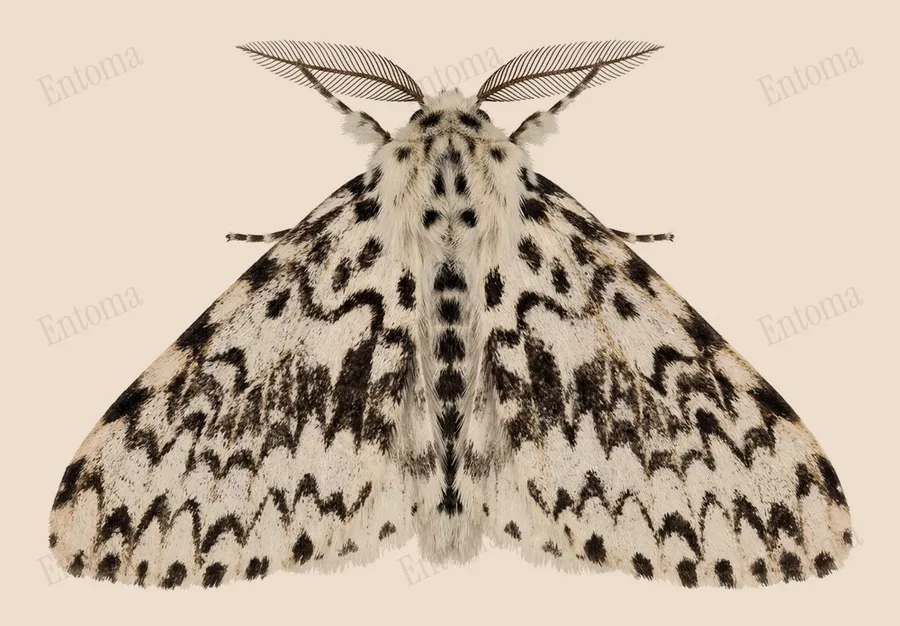
Black arches
This moth's caterpillars hatch with unusually long hairs that catch the wind, letting young larvae balloon away from their birth tree to find fresh foliage.
| Where | Coniferous and mixed broadleaved woodland |
|---|---|
| Size | 36 to 50 mm wingspan |
| When | June to August |
The Black Arches has white forewings crossed by black wavy lines that form loose arch shapes, light brown hindwings with a row of black spots along the fringe, and a pink and black banded abdomen usually hidden beneath the wings at rest. Some individuals are heavily marked with grey or black.
Caterpillars are grey to blackish with rows of hairy warts and feed mainly on oak, sometimes on conifers or birch, occasionally defoliating trees during population outbreaks in parts of central and eastern Europe. Adults fly from June to August, with females capable of flight at night despite their heavier bodies.
Traits
Habitat
Woodland
Colour
White, Black, Brown
Active
Night
To people
Comes to light after dark; harmless to people.
Activity through the year
Often confused with
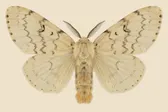
Larger, with a wingspan of about 40 to 70 mm, and a thickset, blunt abdomen in the female rather than the more slender form of the Black Arches.
Questions
Is the Black arches dangerous to people?
Comes to light after dark; harmless to people.
When can you see the Black arches?
The Black arches can be seen from June to August, at night.
Plate retouched from a photo by Ben Sale from Stevenage, UK, CC BY 2.0, Wikimedia Commons Licence
Report a mistake in this entry
Butterflies and moths›Erebid moths›Lymantria
Last updated 2026-09-26. Every entry is checked against published sources.