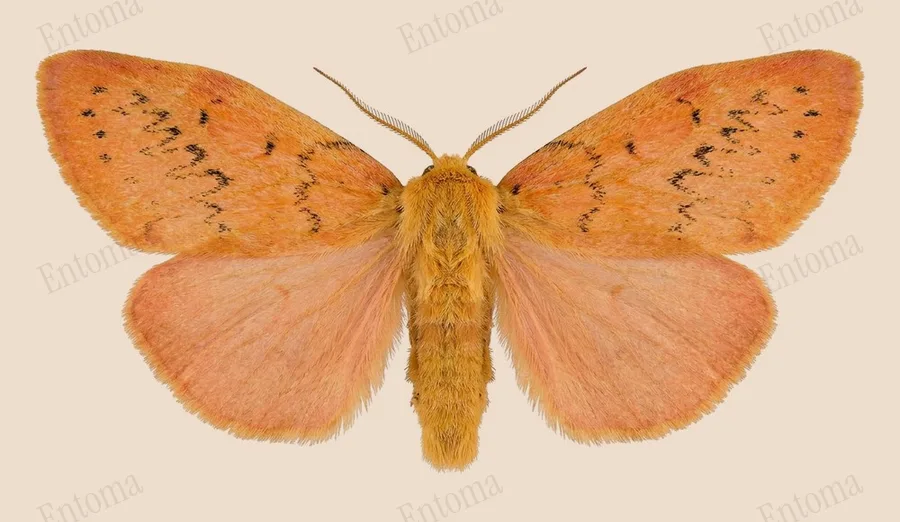
Rosy footman
This moth's caterpillars eat lichen and store its bitter phenolic compounds in their own bodies as a defense against predators.
| Where | Woodland, hedgerows and gardens |
|---|---|
| Size | 23 to 27 mm wingspan |
| When | June to August |
The Rosy Footman has bright orange pink forewings crossed by a fine, wavy black line, with the hindwings a paler rosy shade, and at rest the wings are held tent-like over the body.
Caterpillars are grey with dense long hairs and feed on lichens, particularly dog lichen, growing on the bark of trees and fences. They overwinter as small larvae, feeding again in spring before pupating.
Traits
Habitat
Woodland
Colour
Orange, Black
Active
Night
To people
Attracted to light after dark; harmless to people.
Activity through the year
Often confused with
Slightly larger at about 27 to 30 mm wingspan, and a more uniform bright golden orange without the wavy black line that crosses the Rosy Footman's forewings.
Questions
Is the Rosy footman dangerous to people?
Attracted to light after dark; harmless to people.
When can you see the Rosy footman?
The Rosy footman can be seen from June to August, at night.
Plate retouched from a photo by Didier Descouens, CC BY‑SA 4.0, Wikimedia Commons Licence
The plate on this page is shared under the same licence as its source, CC BY-SA.
Report a mistake in this entry
Butterflies and moths›Erebid moths›Miltochrista
Last updated 2026-09-26. Every entry is checked against published sources.