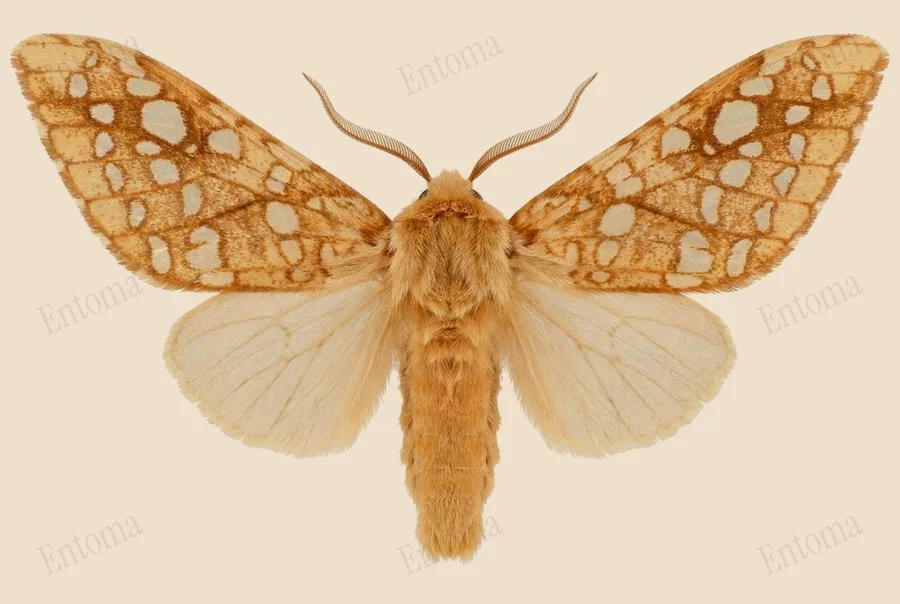
Hickory tussock moth
Its caterpillar is covered in white hairs that look soft, but longer black hairs mixed in can break off in skin and trigger a rash in sensitive people.
| Where | Woodlands and forest edges |
|---|---|
| Size | 37 to 55 mm wingspan |
| When | May to October |
The caterpillar is mostly white and fuzzy, with a row of black tufts down the back and four long black hair pencils projecting from the front and rear ends.
Adults have pale cream to yellowish wings marked with light brown spots and lines, and caterpillars feed on hickory, walnut and other hardwood leaves through summer before overwintering as pupae in the leaf litter.
Traits
Habitat
Woodland
Colour
Yellow, Brown
Active
Night
To people
Mild
Adults are harmless, but the caterpillar's barbed hairs can cause an itchy rash if handled, especially in sensitive people.
Activity through the year
Often confused with
Caterpillar has a yellow or orange band across the middle of the body between black ends, rather than the mostly white body with scattered black tufts of the Hickory tussock moth.
Questions
Is the Hickory tussock moth dangerous to people?
Mild. Adults are harmless, but the caterpillar's barbed hairs can cause an itchy rash if handled, especially in sensitive people.
When can you see the Hickory tussock moth?
The Hickory tussock moth can be seen from May to October, at night.
Plate retouched from a photo by CatherineK, CC BY‑SA 4.0, iNaturalist Licence
The plate on this page is shared under the same licence as its source, CC BY-SA.
Report a mistake in this entry
Butterflies and moths›Erebid moths›Lophocampa
Last updated 2026-09-26. Every entry is checked against published sources.