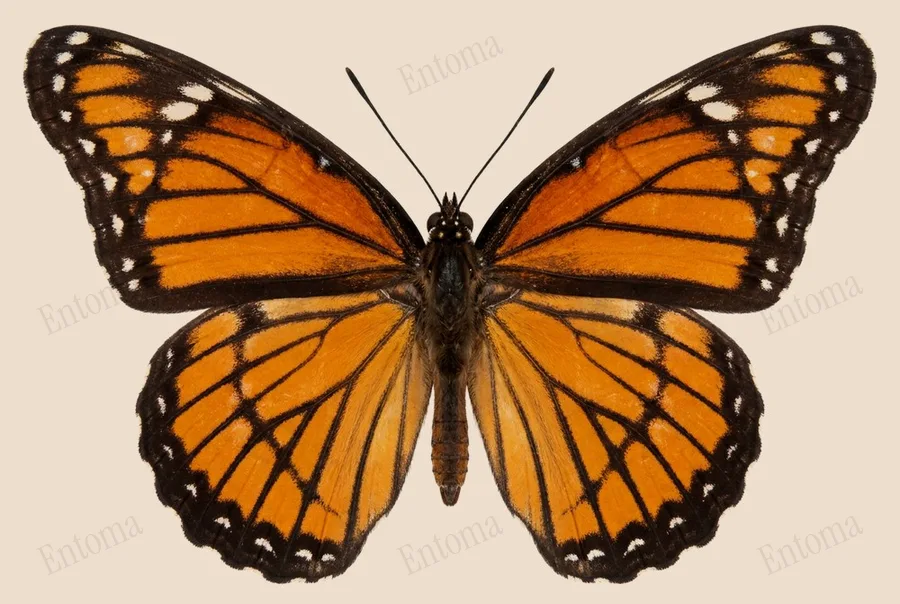
Viceroy
A single black line crossing its hindwing veins is the clearest way to tell a Viceroy from a Monarch, despite their nearly identical orange and black pattern.
| Where | Wet meadows, streamsides and willow thickets |
|---|---|
| Size | 64 to 89 mm wingspan |
| When | May to October |
The Viceroy closely resembles the Monarch in its orange and black pattern with white spots along the wing margins, but a black line crossing the veins of the hindwing sets it apart, and it glides on flat wings rather than the shallow V held by a soaring Monarch.
Caterpillars feed on willow, poplar and aspen leaves in wet meadows, swamp edges and streamsides, and two to three generations fly between late spring and early autumn across most of the United States and southern Canada.
Traits
Habitat
Wetland
Colour
Orange, Black, White
Active
Day
To people
Harmless to people; adults are often seen gliding on flat wings near willows and wet meadows rather than soaring like the Monarch.
Activity through the year
Often confused with
It lacks the black line that crosses the veins of the Viceroy's hindwing, and glides with its wings held in a shallow V rather than flat like the Viceroy.
Questions
Is the Viceroy dangerous to people?
Harmless to people; adults are often seen gliding on flat wings near willows and wet meadows rather than soaring like the Monarch.
When can you see the Viceroy?
The Viceroy can be seen from May to October, by day.
Plate retouched from a photo by Annika Lindqvist, CC BY 4.0, iNaturalist Licence
Report a mistake in this entry
Butterflies and moths›Brush-footed butterflies›Limenitis
Last updated 2026-09-26. Every entry is checked against published sources.