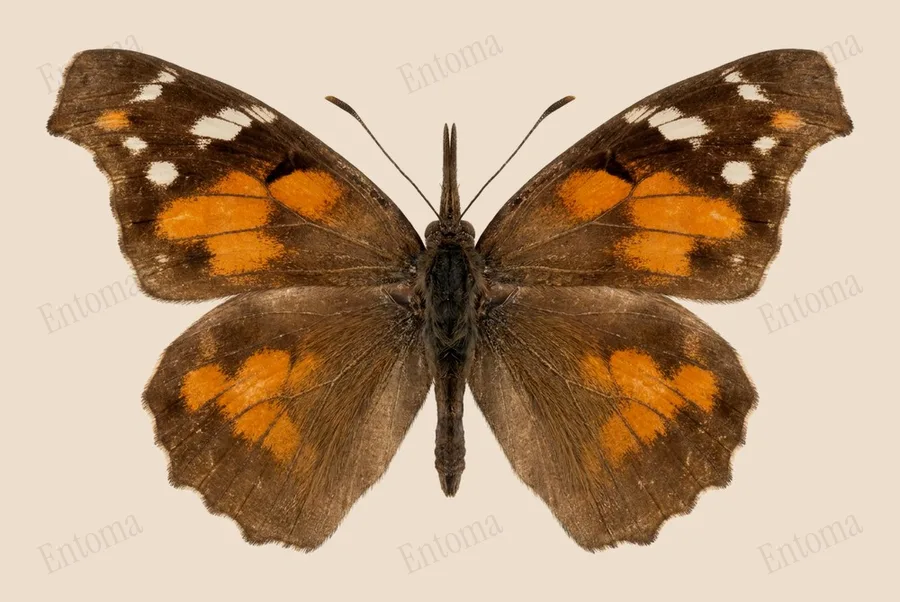
American snout
Its long forward pointing palps and closed wings make it look like a dead leaf, and it can erupt into migrations of millions after rain.
| Where | Woodland edges, scrub and hackberry thickets |
|---|---|
| Size | 35 to 51 mm wingspan |
| When | March to December |
The American snout has unusually long labial palps that project forward like a snout, a squared off forewing tip, and brown upperwings with orange at the base and white spots near the tips. The closed underwings are mottled gray and violet, resembling a dry leaf.
Caterpillars feed only on hackberry trees, and heavy rain that triggers a flush of new hackberry leaves can lead to population explosions and mass northward migrations of the resulting adults across the United States and Canada.
Traits
Habitat
Woodland
Colour
Brown, Orange, White
Active
Day
To people
Sometimes appears in enormous migrating swarms but poses no danger to people.
Activity through the year
Often confused with
Also looks like a dead leaf at rest, but has a hooked forewing tip and orange upperwings, and lacks the American snout's elongated forward pointing palps.
Questions
Is the American snout dangerous to people?
Sometimes appears in enormous migrating swarms but poses no danger to people.
When can you see the American snout?
The American snout can be seen from March to December, by day.
Plate retouched from a photo by Heather Dawnstar Sabin, CC BY 4.0, iNaturalist Licence
Report a mistake in this entry
Butterflies and moths›Brush-footed butterflies›Libytheana
Last updated 2026-09-26. Every entry is checked against published sources.