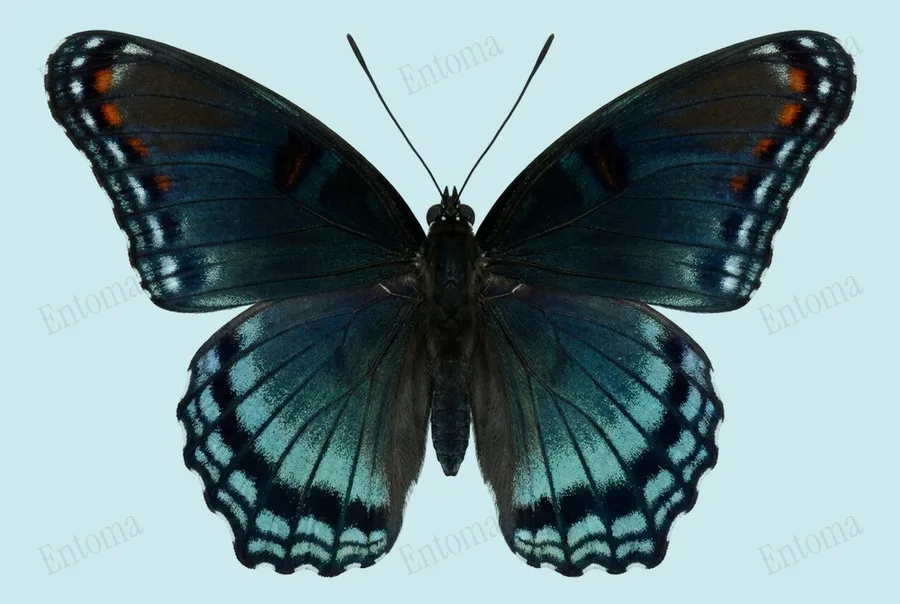
Red-spotted admiral
Its southern form mimics the toxic pipevine swallowtail so closely that predators avoid both, even though this species carries no poison of its own.
| Where | Deciduous forests and woodland edges |
|---|---|
| Size | 47 to 89 mm wingspan |
| When | June to September |
The Red-spotted admiral is black with a strong blue to blue-green sheen across the hindwings and small orange spots near the wing edges on both surfaces. Northern individuals show a bold white band crossing both wings, a feature that fades out toward the south, and unlike a swallowtail it never grows tail-like extensions.
Caterpillars feed on the leaves of black cherry, willow, cottonwood, and several other trees and shrubs, and in autumn a partly grown caterpillar rolls part of a single leaf into a tube, ties it shut with silk, and spends the winter hidden inside before resuming feeding in spring.
Traits
Habitat
Woodland
Colour
Black, Blue, Orange
Active
Day
To people
Does not sting or bite; feeds at mud, sap, and rotting fruit more often than at flowers.
Activity through the year
Often confused with

Both are black with a blue sheen, but the pipevine swallowtail has hindwing tails and shows its orange spots only in a single row on the underside, while the Red-spotted admiral has no tails and carries orange spots on both wing surfaces.
Questions
Is the Red-spotted admiral dangerous to people?
Does not sting or bite; feeds at mud, sap, and rotting fruit more often than at flowers.
When can you see the Red-spotted admiral?
The Red-spotted admiral can be seen from June to September, by day.
Plate retouched from a photo by marissas26, CC0, iNaturalist Licence
Report a mistake in this entry
Butterflies and moths›Brush-footed butterflies›Limenitis
Last updated 2026-09-26. Every entry is checked against published sources.