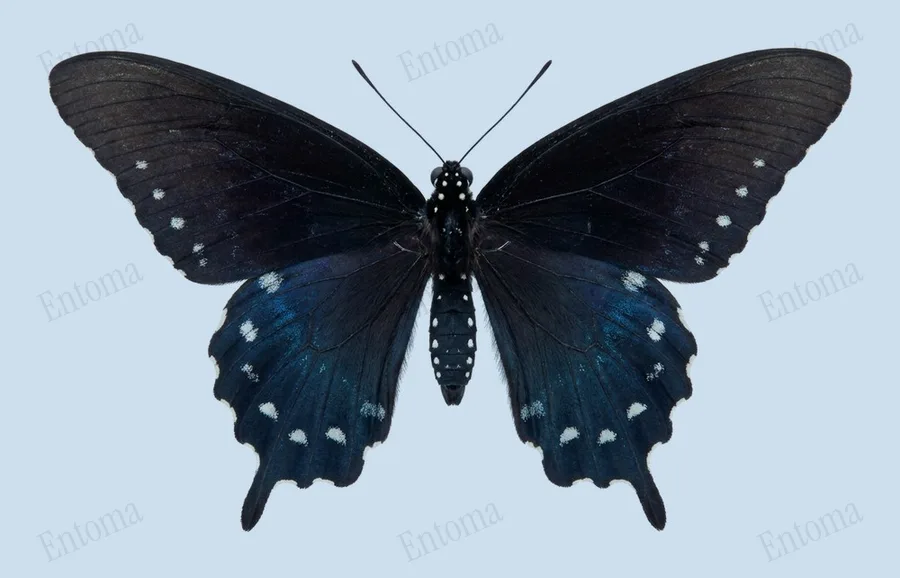
Pipevine swallowtail
Both the caterpillar and adult store bitter acids from pipevine plants in their tissues, making them unsafe to eat even for experienced predators.
| Where | Woodland edges, streambanks, and gardens |
|---|---|
| Size | 70 to 102 mm wingspan |
| When | March to October |
The Pipevine swallowtail is black above with an iridescent blue-green sheen across the hindwings, and below shows a single curved row of seven bright orange spots set against the same iridescent blue, without the tail-like extensions being long.
Caterpillars feed only on pipevine plants of the genus Aristolochia and store the plants' aristolochic acids in their bodies through to the adult stage, and because this makes them so distasteful, several harmless butterfly species have evolved dark coloring that copies its appearance.
Traits
Habitat
Woodland
Colour
Black, Blue
Active
Day
To people
Mild
Not for eating; caterpillars and adults carry aristolochic acid that is toxic if ingested, though the butterfly cannot sting or bite.
Activity through the year
Often confused with
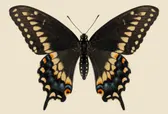
Female Black swallowtails mimic the Pipevine swallowtail's dark coloring, but they are smaller with hindwing tails and two rows of yellow-orange spots underneath, while the Pipevine swallowtail shows only a single row of orange spots.
Questions
Is the Pipevine swallowtail dangerous to people?
Mild. Not for eating; caterpillars and adults carry aristolochic acid that is toxic if ingested, though the butterfly cannot sting or bite.
When can you see the Pipevine swallowtail?
The Pipevine swallowtail can be seen from March to October, by day.
Plate retouched from a photo by Paul Prior, CC BY 4.0, iNaturalist Licence
Report a mistake in this entry
Butterflies and moths›Swallowtails›Battus
Last updated 2026-09-26. Every entry is checked against published sources.