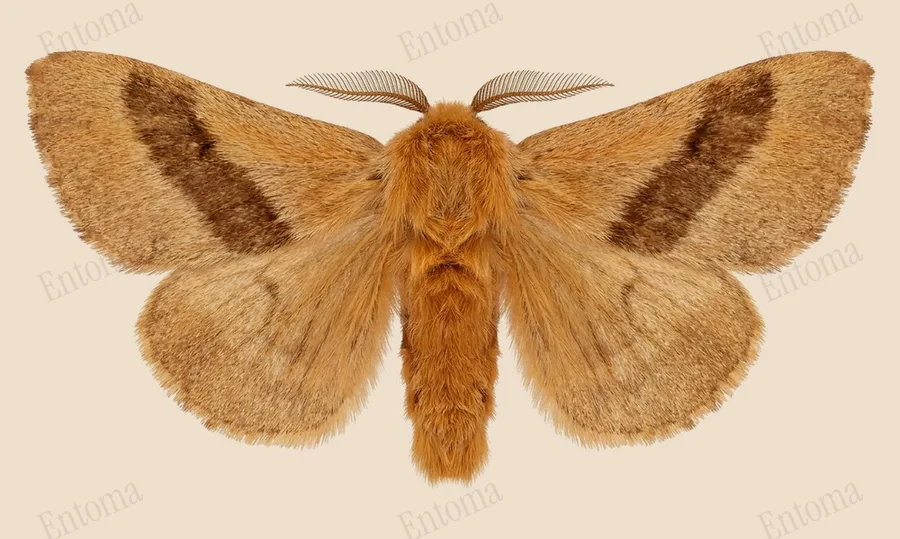
Forest tent caterpillar moth
Despite its name, this species builds no tent at all, resting instead on silk mats on tree trunks between feeding bouts during periodic outbreaks that can defoliate forests.
| Where | Hardwood forests across North America |
|---|---|
| Size | 25 to 50 mm wingspan |
| When | March to July |
The adult is a tan to yellowish brown moth with a wingspan of about 25 to 50 mm and two faint, darker diagonal bands crossing each forewing. Caterpillars are dark gray to brownish black with a row of pale, keyhole shaped spots down the back and thin blue lines along each side.
Rather than spinning a true tent, groups of caterpillars rest together on silk mats laid over trunks and branches between feeding periods. Populations build up every ten to twenty years to strip oaks, maples, aspen and other hardwoods bare, though healthy trees usually recover after a year or two of defoliation.
Traits
Habitat
Woodland
Colour
Brown, Yellow, Blue
Active
Night
To people
Does not bite, sting or irritate skin; large outbreaks are mainly a concern for trees rather than people.
Activity through the year
Often confused with
Its caterpillar has a solid white stripe down the center of the back rather than a row of pale keyhole shaped spots, and it builds a true silk tent in branch forks instead of open resting mats.
Questions
Is the Forest tent caterpillar moth dangerous to people?
Does not bite, sting or irritate skin; large outbreaks are mainly a concern for trees rather than people.
When can you see the Forest tent caterpillar moth?
The Forest tent caterpillar moth can be seen from March to July, at night.
Plate retouched from a photo by Bill Keim, CC BY 4.0, iNaturalist Licence
Report a mistake in this entry
Butterflies and moths›Lappet moths›Malacosoma
Last updated 2026-09-26. Every entry is checked against published sources.