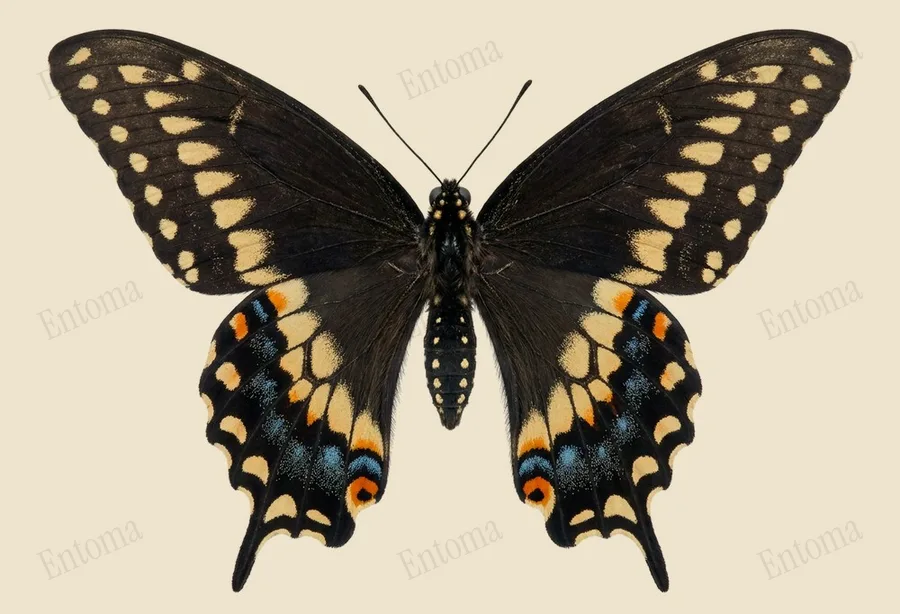
Black swallowtail
Black Swallowtail caterpillars flash a forked, foul-smelling orange gland from behind the head, called an osmeterium, to startle birds and ants.
| Where | Open fields, meadows and gardens |
|---|---|
| Size | 76 to 108 mm wingspan |
| When | April to October |
Adults are black above with two rows of yellow spots, and the hindwing carries a row of orange crescents including one spot with a black center that helps separate this species from other dark swallowtails. Wingspan runs from about 76 to 108 millimeters, with females typically larger than males.
Caterpillars feed on plants in the carrot family, including wild carrot, dill and parsley, and two to three generations fly between spring and early fall across most of the range.
Traits
Habitat
Garden
Colour
Black, Yellow, Orange
Active
Day
To people
A frequent garden visitor on parsley, dill and carrot plants; harmless to people.
Activity through the year
Often confused with
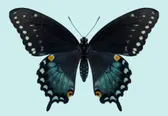
The paired orange spot near the hindwing's inner corner is plain orange, without the black center found in the Black Swallowtail.
Questions
Is the Black swallowtail dangerous to people?
A frequent garden visitor on parsley, dill and carrot plants; harmless to people.
When can you see the Black swallowtail?
The Black swallowtail can be seen from April to October, by day.
Plate retouched from a photo by Arlo Sitimans, CC BY 4.0, iNaturalist Licence
Report a mistake in this entry
Butterflies and moths›Swallowtails›Papilio
Last updated 2026-09-26. Every entry is checked against published sources.