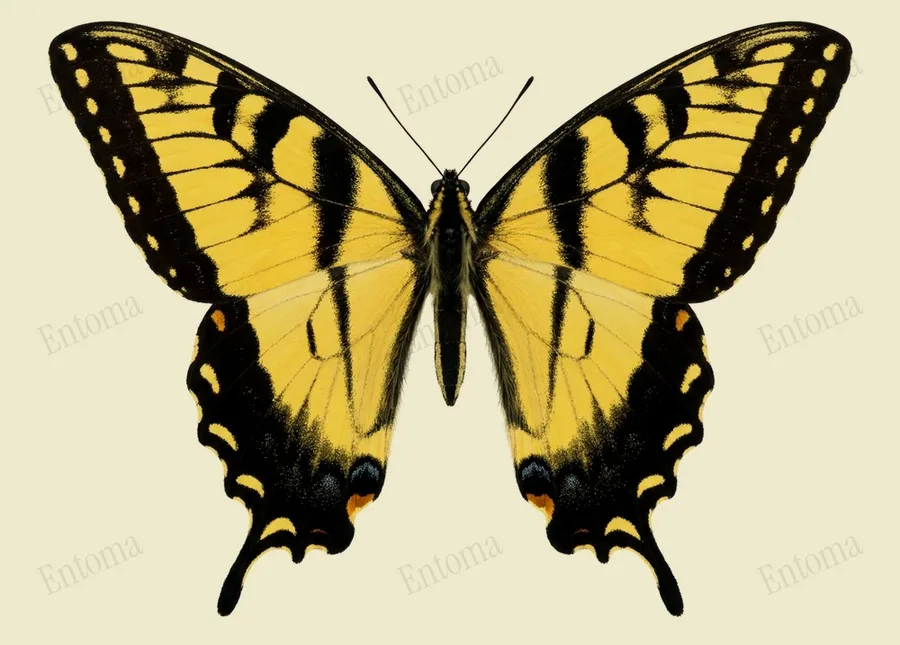
Western tiger swallowtail
Young caterpillars look like bird droppings, but older ones turn green with large fake eyespots that make the head end resemble a small snake.
| Where | Riparian woodlands, canyons and gardens |
|---|---|
| Size | 70 to 100 mm wingspan |
| When | March to August |
The Western tiger swallowtail is yellow with bold black tiger stripes, blue spots along the hindwing margin, and a single pair of tails, seen flying through canyons, riparian woodlands, and gardens across western North America.
Caterpillars feed on willow, cottonwood, aspen, and ash leaves and change dramatically as they grow, shifting from a dark, bird dropping like pattern to a smooth green body with large eyespots that mimic a snake's head.
Traits
Habitat
Woodland
Colour
Yellow, Black, Blue
Active
Day
To people
A common sight in gardens and parks, sipping nectar and puddling at damp soil without harming people.
Activity through the year
Often confused with
Has two tails on each hindwing instead of one, giving it four tails in total, and shows narrower black stripes than the Western tiger swallowtail.
Questions
Is the Western tiger swallowtail dangerous to people?
A common sight in gardens and parks, sipping nectar and puddling at damp soil without harming people.
When can you see the Western tiger swallowtail?
The Western tiger swallowtail can be seen from March to August, by day.
Plate retouched from a photo by Andrii Khmelkov, CC BY‑SA 4.0, iNaturalist Licence
The plate on this page is shared under the same licence as its source, CC BY-SA.
Report a mistake in this entry
Butterflies and moths›Swallowtails›Papilio
Last updated 2026-09-26. Every entry is checked against published sources.