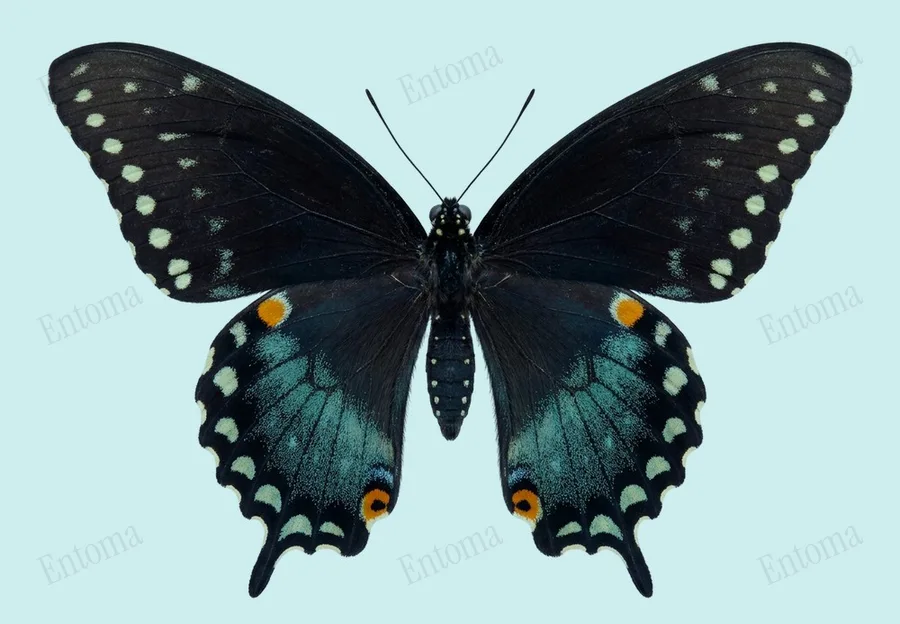
Spicebush swallowtail
Young spicebush swallowtail caterpillars fold a leaf into a shelter and develop two swollen, eyespotted humps near the head that make them resemble a small snake.
| Where | Deciduous woodlands and forest edges |
|---|---|
| Size | 75 to 115 mm wingspan |
| When | April to September |
The spicebush swallowtail is mostly black above with a curved row of pale spots along the wing margins and a clear orange spot near the inner corner of the hindwing, above a wash of blue-green scales in males or blue in females. The hindwing tail is broad and spoon-shaped rather than narrow.
Caterpillars feed on spicebush and sassafras in deciduous woodlands and forest edges across the eastern United States and adjoining Canada, sheltering in a folded leaf and developing false eyespots as they grow. Adults resemble the foul-tasting pipevine swallowtail, which likely offers them some protection from predators.
Traits
Habitat
Woodland
Colour
Black, Blue, Orange
Active
Day
To people
Visits garden flowers for nectar; harmless to handle.
Activity through the year
Often confused with

Shows iridescent blue-green across most of the hindwing upperside rather than a single orange spot, and a single row of pale spots beneath the hindwing rather than two rows of orange spots.
Questions
Is the Spicebush swallowtail dangerous to people?
Visits garden flowers for nectar; harmless to handle.
When can you see the Spicebush swallowtail?
The Spicebush swallowtail can be seen from April to September, by day.
Plate retouched from a museum specimen photo by Davidson College, CC0, GBIF Licence
Report a mistake in this entry
Butterflies and moths›Swallowtails›Papilio
Last updated 2026-09-26. Every entry is checked against published sources.