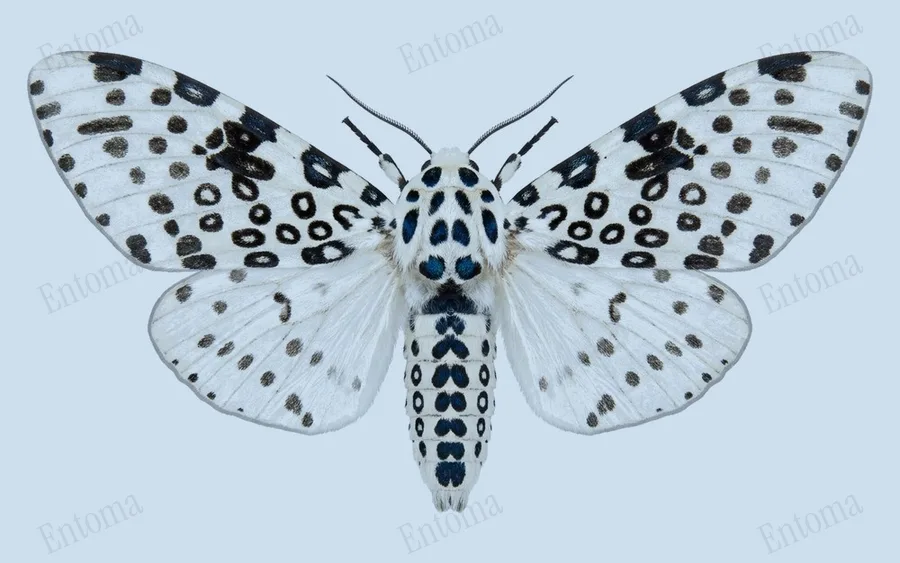
Giant leopard moth
When disturbed, its woolly caterpillar curls into a tight ball, flashing bright red or orange bands between its segments that are hidden the rest of the time.
| Where | Deciduous forests, fields and gardens |
|---|---|
| Size | 57 to 91 mm wingspan |
| When | March to November |
The adult giant leopard moth has bright white wings marked with bold black spots, some solid and some hollow, and an iridescent blue abdomen banded with orange. It is one of the larger tiger moths in North America, with a wingspan of about 57 to 91 mm.
Caterpillars are covered in black bristles hiding red bands between the segments and feed on a wide variety of low plants and shrubs. Despite their fierce, bristly look the hairs do not sting or cause irritation, and the species overwinters as a partly grown caterpillar before pupating in spring.
Traits
Habitat
Woodland
Colour
White, Black, Blue
Active
Night
To people
A common visitor to porch lights at night; its bristly caterpillar looks fierce but does not sting or irritate skin.
Activity through the year
Often confused with
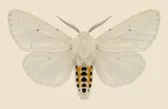
Also a white tiger moth found across North America, but nearly unmarked with only a few small black spots, lacking the giant leopard moth's bold black blotches and blue abdomen.
Questions
Is the Giant leopard moth dangerous to people?
A common visitor to porch lights at night; its bristly caterpillar looks fierce but does not sting or irritate skin.
When can you see the Giant leopard moth?
The Giant leopard moth can be seen from March to November, at night.
Plate retouched from a photo by Chelsea Carroll, CC BY 4.0, iNaturalist Licence
Report a mistake in this entry
Butterflies and moths›Erebid moths›Hypercompe
Last updated 2026-09-26. Every entry is checked against published sources.