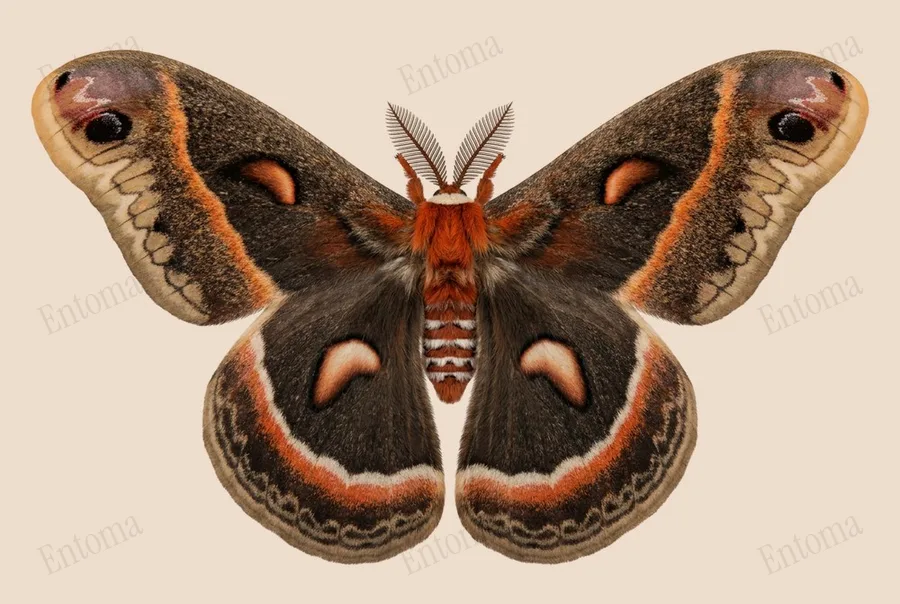
Cecropia moth
As North America's largest moth, it has no working mouthparts as an adult and lives for only about two weeks, surviving on fat stored from its caterpillar days.
| Where | Deciduous forests, orchards and gardens |
|---|---|
| Size | 95 to 180 mm wingspan |
| When | March to September |
The Cecropia moth is dark brown to gray above, with a red patch and white band near each forewing base and a reddish-rimmed white crescent at the center of all four wings; the body is red with a white collar.
Caterpillars are bluish green with rows of colorful tubercles and feed on the leaves of maples, cherries, willows and many other trees and shrubs, spinning a tough brown cocoon fixed to a twig where they spend the winter as a pupa.
Traits
Habitat
Woodland
Colour
Brown, Red, White
Active
Night
To people
Harmless to people; adults do not feed at all and are simply drawn to lights at night.
Activity through the year
Often confused with
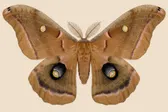
The Polyphemus moth carries one large, purplish eyespot on each hindwing rather than the small reddish-rimmed white crescents found on all four wings of the Cecropia moth.
Questions
Is the Cecropia moth dangerous to people?
Harmless to people; adults do not feed at all and are simply drawn to lights at night.
When can you see the Cecropia moth?
The Cecropia moth can be seen from March to September, at night.
Plate retouched from a photo by Marilyne Busque-Dubois, CC BY 4.0, iNaturalist Licence
Report a mistake in this entry
Butterflies and moths›Emperor moths›Hyalophora
Last updated 2026-09-27. Every entry is checked against published sources.