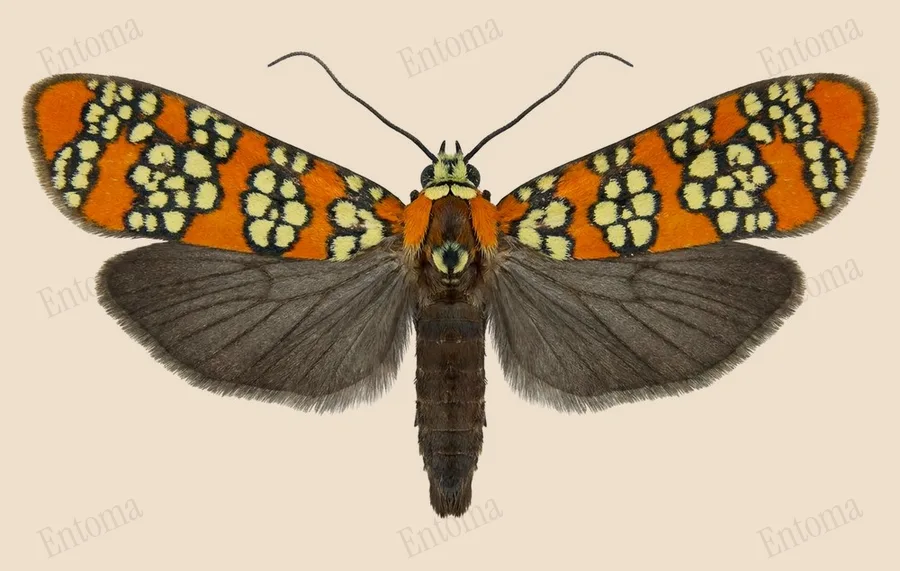
Ailanthus webworm moth
This day-flying moth rests with its wings rolled into a tight tube along its body, giving it the silhouette of a beetle rather than a moth.
| Where | Tree of heaven groves and roadsides |
|---|---|
| Size | 18 to 26 mm wingspan |
| When | May to November |
The Ailanthus webworm moth has slender orange forewings marked with rows of small white spots outlined in black, and it holds its wings tightly wrapped around the body at rest, unlike most moths.
Caterpillars live communally in silk webs spun over the leaves of the tree of heaven, and the moth's range has expanded north across the United States and Canada along with that introduced tree.
Traits
Habitat
Towns
Colour
Orange, Black, White
Active
Day
To people
Feeds on flower nectar and does not sting or bite; safe to observe closely.
Activity through the year
Often confused with
Larger, with a wingspan of 33 to 46 mm and forewings patterned in bands of black dots rather than the ailanthus webworm's scattered white spots ringed in black.
Questions
Is the Ailanthus webworm moth dangerous to people?
Feeds on flower nectar and does not sting or bite; safe to observe closely.
When can you see the Ailanthus webworm moth?
The Ailanthus webworm moth can be seen from May to November, by day.
Plate retouched from a museum specimen photo by Mississippi Entomological Museum, CC0, GBIF Licence
Report a mistake in this entry
Butterflies and moths›Tropical ermine moths›Atteva
Last updated 2026-09-26. Every entry is checked against published sources.