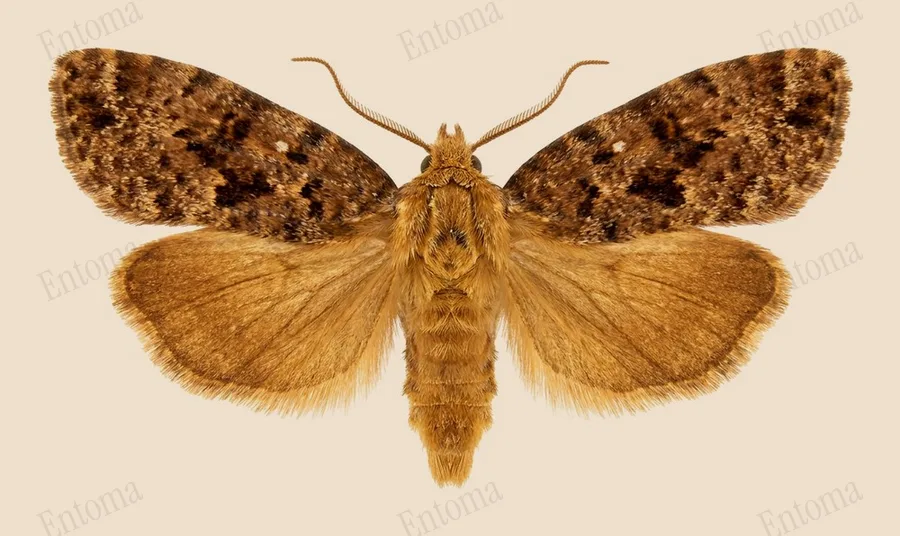
Clemens' grass tubeworm moth
Larvae of this moth build silk-lined tunnels reaching deep into the soil around the roots of clover and other plants, sheltering there as they feed.
| Where | Grasslands, roadsides, open weedy ground |
|---|---|
| Size | 24 to 33 mm wingspan |
| When | June to September |
Clemens' grass tubeworm moth has dark brown forewings marked with lighter brown blotches and a flush of golden orange near the base, with a tuft of long, hairlike scales above the head that gives it a helmeted look. The wingspan runs from about 24 to 33 mm.
Larvae live in silk-lined tubes at or just below the soil surface and feed on the roots of clover and other herbaceous plants. Adults are found from early summer into early autumn across grasslands, agricultural land and weedy urban ground.
Traits
Habitat
Grassland
Colour
Brown, Orange
Active
Night
To people
Harmless to people; adults are drawn to lights at night but do not bite or sting.
Activity through the year
Often confused with
Often shows a reddish tinge to the wings and, in males, long palps that arch up and over the thorax, a feature not seen in Clemens' grass tubeworm moth.
Questions
Is the Clemens' grass tubeworm moth dangerous to people?
Harmless to people; adults are drawn to lights at night but do not bite or sting.
When can you see the Clemens' grass tubeworm moth?
The Clemens' grass tubeworm moth can be seen from June to September, at night.
Plate retouched from a museum specimen photo by Mississippi Entomological Museum, CC0, GBIF Licence
Report a mistake in this entry
Butterflies and moths›Fungus moths›Acrolophus
Last updated 2026-09-27. Every entry is checked against published sources.