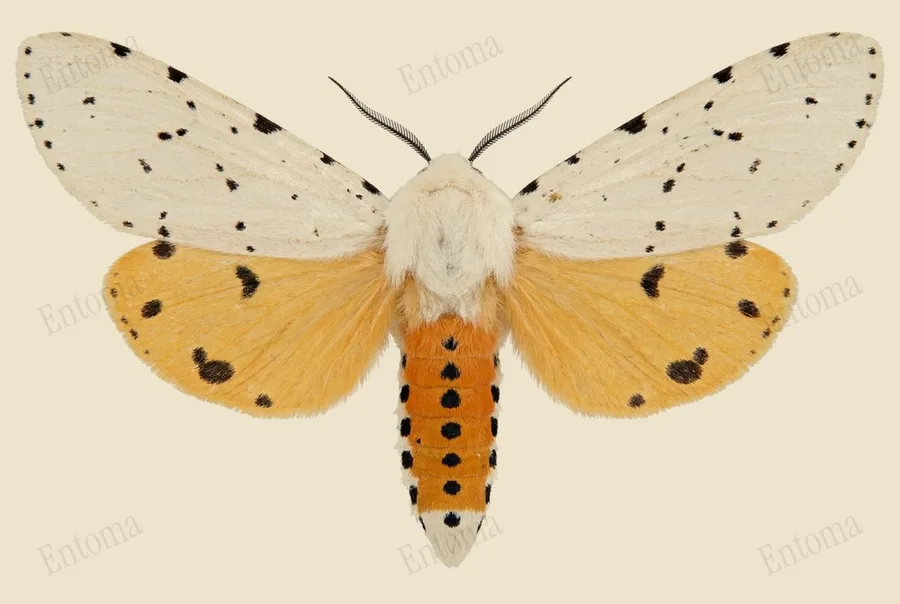
Salt marsh moth
Its caterpillars are so unfussy that they feed on garden vegetables, field crops and roadside weeds alike, rather than favoring one host plant.
| Where | Open fields, farmland and marshes |
|---|---|
| Size | 35 to 70 mm wingspan |
| When | March to November |
The Salt marsh moth's caterpillar is covered in dense long hairs, black at both ends with a reddish brown band across the middle and yellow spots along the sides, giving it a shaggy, woolly look. The adult moth itself is smaller and plainer, with pale wings marked by scattered black spots.
Caterpillars feed on an unusually wide range of garden vegetables, field crops and weeds rather than a single host plant, and their bristly hairs can mildly irritate the skin of sensitive people who handle them.
Traits
Habitat
Farmland
Colour
White, Yellow, Black
Active
Night
To people
Mild
Caterpillars carry bristly hairs that can irritate sensitive skin; adults are attracted to light and do not bite or sting.
Activity through the year
Often confused with
Its caterpillar is less densely haired and ranges from pale yellow to rust, without the dense black-banded, yellow-spotted hairs of the Salt marsh moth caterpillar.
Questions
Is the Salt marsh moth dangerous to people?
Mild. Caterpillars carry bristly hairs that can irritate sensitive skin; adults are attracted to light and do not bite or sting.
When can you see the Salt marsh moth?
The Salt marsh moth can be seen from March to November, at night.
Plate retouched from a museum specimen photo by AJ Thomas, Colorado State University, C.P. Gillette Museum of Arthropod Diversity, CC0, GBIF Licence
Report a mistake in this entry
Butterflies and moths›Erebid moths›Estigmene
Last updated 2026-09-26. Every entry is checked against published sources.