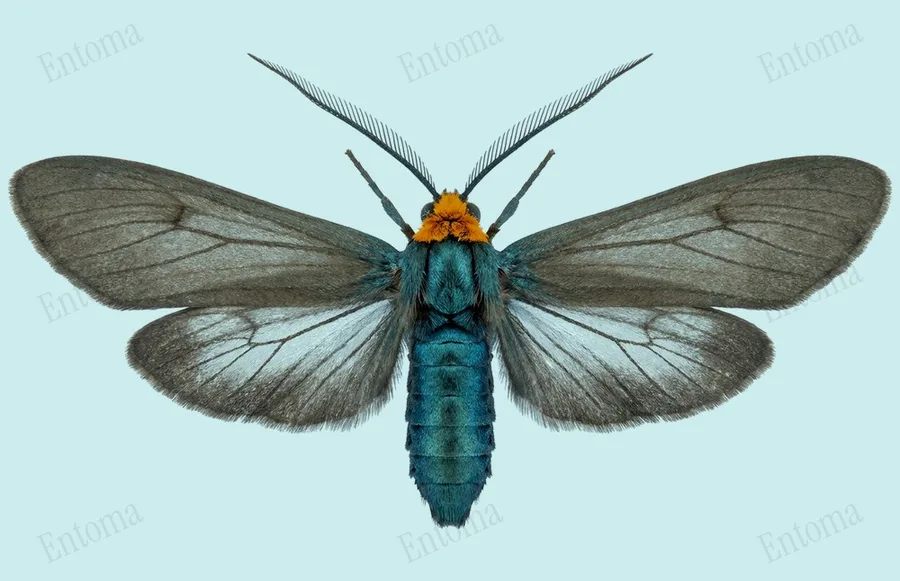
Virginia ctenucha
The largest wasp-mimicking moth in North America flies by day on feathery antennae, then still comes readily to a porch light after dark.
| Where | Damp meadows, fields and open grassland |
|---|---|
| Size | 35 to 51 mm wingspan |
| When | April to July |
The Virginia ctenucha is a metallic blue green moth with a bright orange head and orange scales along the sides of the collar, plus feathery antennae that are bushier in males. The forewing is dark greyish brown with a metallic blue base, and the hindwing is black with a white fringed edge.
Adults fly by day over damp meadows and fields, visiting goldenrod and other flowers, though they will also come to light after dark. Caterpillars feed on grasses, sedges and irises, and the species has expanded west into the Canadian Rockies over the last several decades.
Traits
Habitat
Grassland
Colour
Metallic, Orange, Black
Active
Day and night
To people
Feeds on flower nectar by day; does not bite or sting people.
Activity through the year
Often confused with
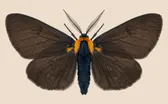
Somewhat smaller with an orange collar that wraps evenly around the neck and pale, translucent hindwings, unlike the Virginia ctenucha's blue-green body and solid black, white-fringed hindwing.
Questions
Is the Virginia ctenucha dangerous to people?
Feeds on flower nectar by day; does not bite or sting people.
When can you see the Virginia ctenucha?
The Virginia ctenucha can be seen from April to July, by day and at night.
Plate retouched from a museum specimen photo by AJ Thomas, Colorado State University, C.P. Gillette Museum of Arthropod Diversity, CC0, GBIF Licence
Report a mistake in this entry
Butterflies and moths›Erebid moths›Ctenucha
Last updated 2026-09-26. Every entry is checked against published sources.