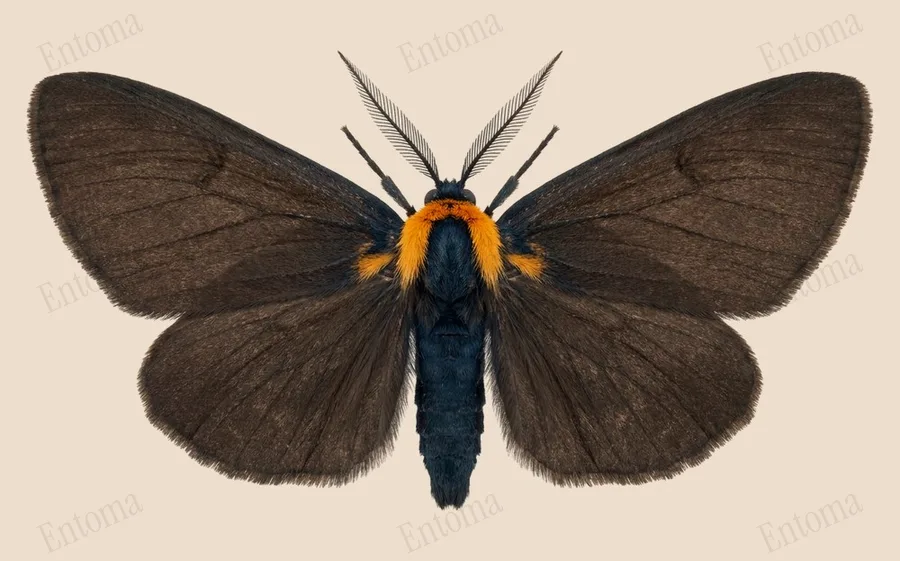
Yellow-collared scape moth
Its narrow black wings and bright orange collar make it a convincing wasp mimic, though it has no sting at all.
| Where | Fields, prairies and forest edges |
|---|---|
| Size | 25 to 38 mm wingspan |
| When | May to November |
The Yellow-collared scape moth has slender black forewings with a faint pale margin and translucent grey hindwings that show through in flight. A bright orange or yellow collar crosses the top of the thorax, and the rest of the body is a glossy blue black, giving the whole insect a narrow, wasp-like outline.
Adults fly from spring through late autumn across fields, prairies and forest edges, visiting flowers by day and coming to lights after dark. Caterpillars feed on grasses and sedges and grow a coat of soft, sparse hairs before pupating in a thin silk cocoon.
Traits
Habitat
Grassland
Colour
Black, Orange
Active
Day and night
To people
Visits flowers by day and lights at night; harmless to handle.
Activity through the year
Often confused with
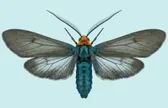
Larger at about 40 to 50 mm wingspan, with a shiny dark blue thorax and a triangular collar instead of the narrow orange band of the Yellow-collared scape moth.
Questions
Is the Yellow-collared scape moth dangerous to people?
Visits flowers by day and lights at night; harmless to handle.
When can you see the Yellow-collared scape moth?
The Yellow-collared scape moth can be seen from May to November, by day and at night.
Plate retouched from a photo by Justin Williams, CC BY 4.0, iNaturalist Licence
Report a mistake in this entry
Butterflies and moths›Erebid moths›Cisseps
Last updated 2026-09-26. Every entry is checked against published sources.