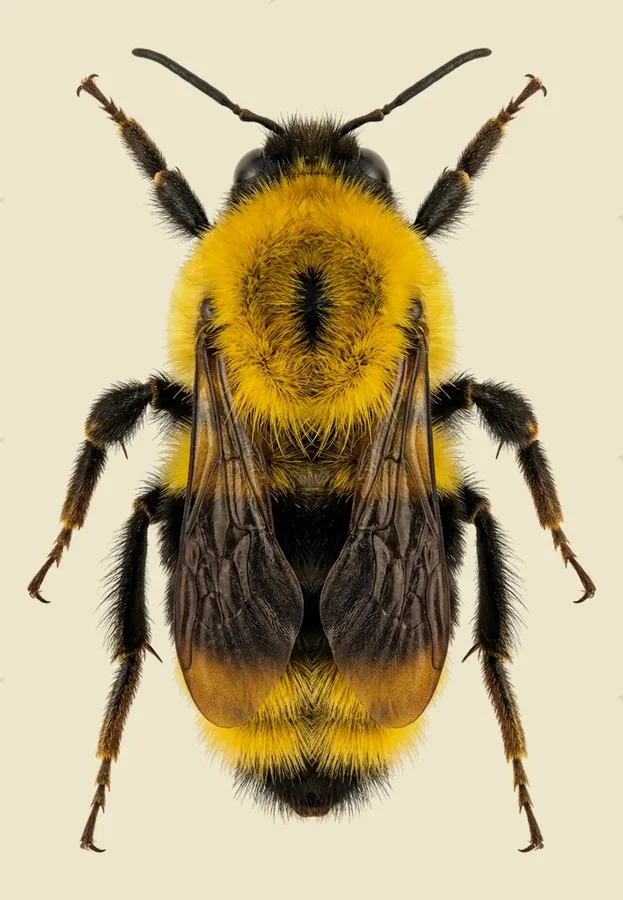
Golden northern bumble bee
This bumble bee nests both above and below ground, in rodent burrows or thick grass clumps, and its queens grow to about 25 mm long.
| Where | Open meadows, fields and roadsides |
|---|---|
| Size | 14 to 25 mm body length |
| When | May to September |
The Golden northern bumble bee is a large, mostly golden yellow bumble bee with a black head, a black band between the wings and smoky, dark wings. Queens reach about 25 mm long, distinctly larger than the roughly 19 mm workers, and males have yellow facial hair.
A mated queen overwinters alone and starts a new colony each spring, laying her first eggs in a nest built of dried grass either above or below ground. She and her workers forage on flowers with deep throats such as clover, bee balm and vetch, and the colony grows through summer before declining in autumn.
Traits
Habitat
Grassland
Colour
Yellow, Black
Active
Day
To people
Take care
Females can sting and will defend the nest, though this bumble bee is not aggressive away from it.
Activity through the year
Often confused with
Also large and mostly yellow, but has yellow hairs mixed through the top of the thorax rather than the solid black band between the wings of the Golden northern bumble bee.
Similarly pale yellow, but queens and workers show a black spot in the center of an otherwise yellow thorax, which the Golden northern bumble bee lacks.
Questions
Is the Golden northern bumble bee dangerous to people?
Take care. Females can sting and will defend the nest, though this bumble bee is not aggressive away from it.
When can you see the Golden northern bumble bee?
The Golden northern bumble bee can be seen from May to September, by day.
Plate retouched from a museum specimen photo by AJ Thomas, Colorado State University, C.P. Gillette Museum of Arthropod Diversity, CC0, GBIF Licence
Report a mistake in this entry
Bees, wasps and ants›Bees and bumblebees›Bombus
Last updated 2026-09-27. Every entry is checked against published sources.