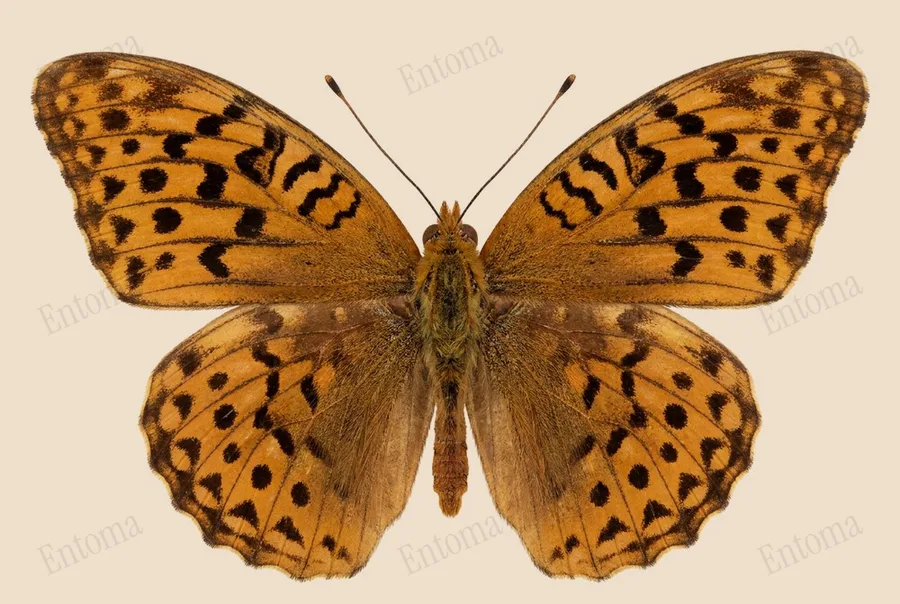
Great spangled fritillary
Newly hatched caterpillars of this butterfly do not eat at all; they spend the entire winter dormant and only start feeding on violets once fresh spring growth appears.
| Where | Meadows, fields and woodland edges |
|---|---|
| Size | 62 to 100 mm wingspan |
| When | May to September |
The Great spangled fritillary is a large orange and black butterfly, with silver spots covering the underside of the hindwing and a wide yellow band running between two rows of those spots.
Females lay eggs near violets in late summer, and the caterpillars hatch soon after but do not feed, staying dormant through winter until fresh violet leaves emerge the following spring.
Traits
Habitat
Grassland
Colour
Orange, Black, Brown
Active
Day
To people
Visits flowers for nectar and poses no danger to people.
Activity through the year
Often confused with
The yellow band between the two rows of silver spots on the underside is narrower on the Aphrodite fritillary, which also has a small black dot near the forewing base that the Great spangled fritillary lacks.
Questions
Is the Great spangled fritillary dangerous to people?
Visits flowers for nectar and poses no danger to people.
When can you see the Great spangled fritillary?
The Great spangled fritillary can be seen from May to September, by day.
Plate retouched from a museum specimen photo by Davidson College, CC0, GBIF Licence
Report a mistake in this entry
Butterflies and moths›Brush-footed butterflies›Argynnis
Last updated 2026-09-26. Every entry is checked against published sources.