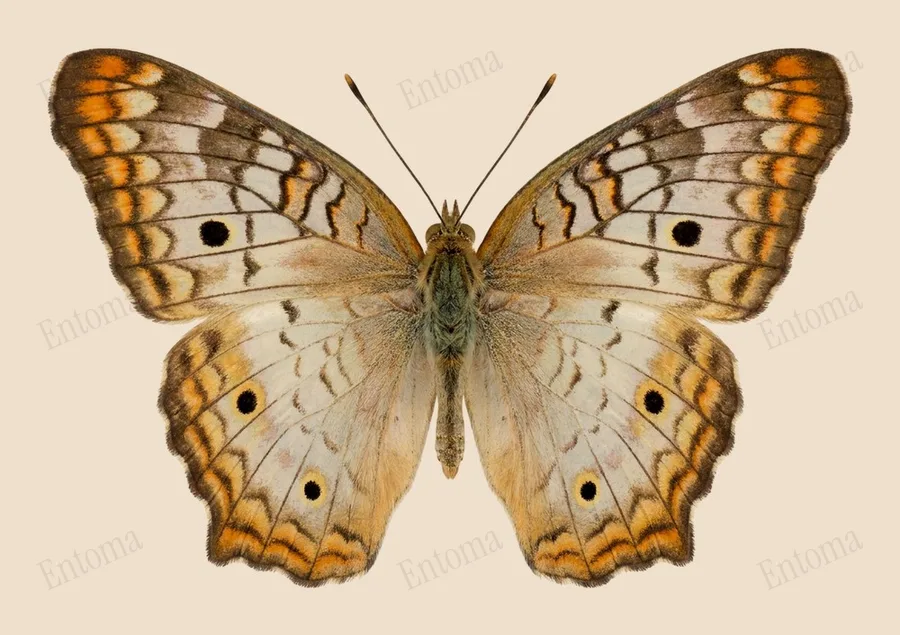
White peacock
Males guard sunlit patches of bare, damp ground for hours, launching at any rival that intrudes and returning to the very same perch.
| Where | Damp open ground near water |
|---|---|
| Size | 51 to 70 mm wingspan |
| When | January to December |
The White peacock is a chalky white to off-white butterfly crossed by faint tan bands, with a wingspan of about 51 to 70 mm. Each forewing carries one dark eyespot and each hindwing carries two, and the outer wing edge is scalloped rather than rounded.
Adults fly low and close to the ground in damp open habitats such as ditches, marsh edges and wet fields, breeding continuously where winters stay mild. Caterpillars feed on frogfruit and water hyssop and are black with branched spines and two horns on the head.
Traits
Habitat
Wetland
Colour
White, Orange, Brown
Active
Day
To people
Territorial toward other butterflies but harmless to people.
Activity through the year
Often confused with
Lacks the White peacock's black eyespots and brown crescent trim, appearing plain white with a black-lined forewing tip and turquoise antenna tips instead.
Questions
Is the White peacock dangerous to people?
Territorial toward other butterflies but harmless to people.
When can you see the White peacock?
The White peacock can be seen from January to December, by day.
Plate retouched from a photo by Carlos Alexandre Mattos Raposo, CC BY 4.0, iNaturalist Licence
Report a mistake in this entry
Butterflies and moths›Brush-footed butterflies›Anartia
Last updated 2026-09-27. Every entry is checked against published sources.