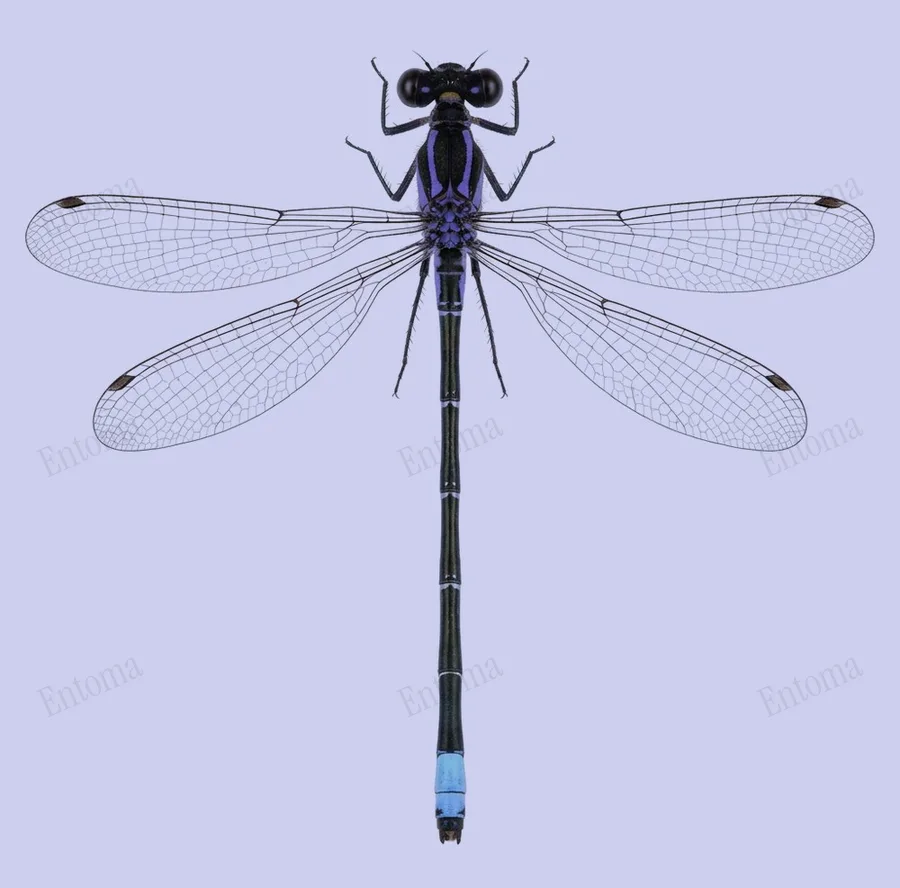
Blue-tipped dancer
Adult males are almost entirely black except for two sky-blue segments at the tip of the abdomen, which give the species its common name.
| Where | Rivers and streams in eastern North America |
|---|---|
| Size | 30 to 38 mm body length |
| When | April to August |
Male Blue-tipped dancers have a violet-tinged thorax with pale sides and an abdomen that is almost entirely black except for the ninth and tenth segments, which are bright blue. Females are more variable, appearing either plain brown or marked with blue on the head, thorax and abdomen.
This damselfly lives along rivers, streams and bottomland forest edges, where males perch on shaded rocks and low vegetation or hover just above the water. Pairs lay eggs in clumps on floating leaves, twigs and wet wood just above the surface.
Traits
Habitat
Wetland
Colour
Black, Blue, Brown
Active
Day
To people
Harmless to people; it neither bites nor stings and is usually seen perched near flowing water.
Activity through the year
Often confused with
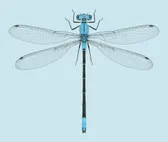
Similar in length at about 33 to 40 mm, but males have an all-blue thorax (blackish only when cold) and three pale-blue segments at the abdomen tip, compared to the Blue-tipped dancer's violet-tinged thorax and only two blue tip segments.
Questions
Is the Blue-tipped dancer dangerous to people?
Harmless to people; it neither bites nor stings and is usually seen perched near flowing water.
When can you see the Blue-tipped dancer?
The Blue-tipped dancer can be seen from April to August, by day.
Plate retouched from a photo by Jeff Niznik, CC BY‑SA 4.0, iNaturalist Licence
The plate on this page is shared under the same licence as its source, CC BY-SA.
Report a mistake in this entry
Dragonflies and damselflies›Narrow-winged damselflies›Argia
Last updated 2026-09-27. Every entry is checked against published sources.