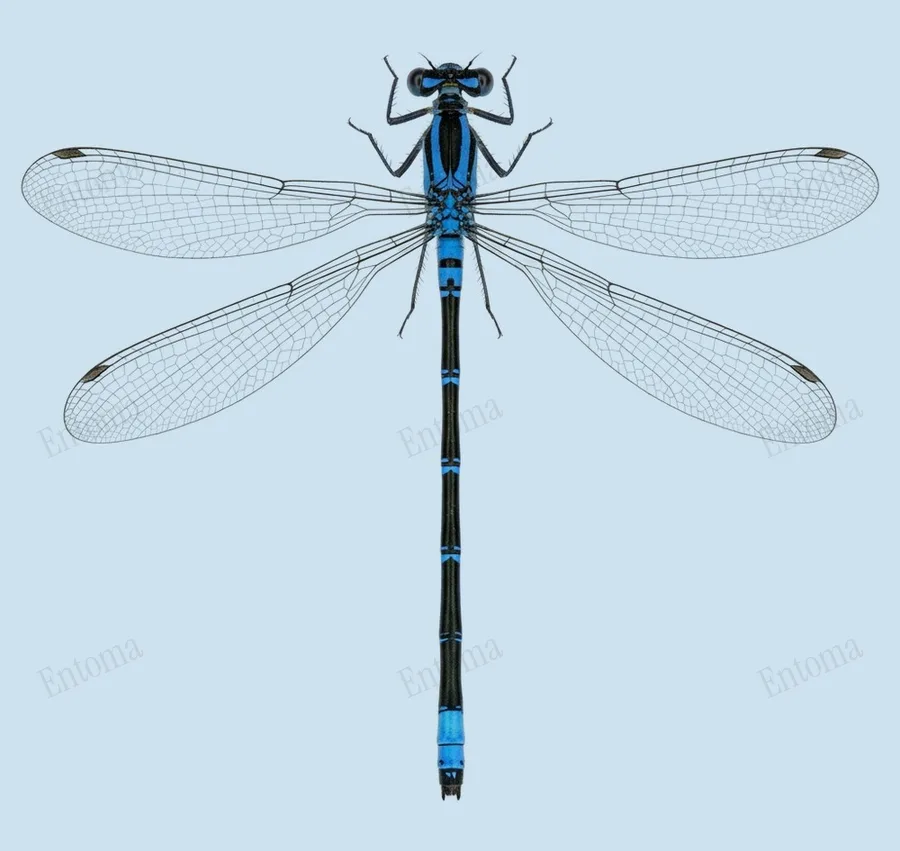
Blue-ringed dancer
Male Blue-ringed dancers have a black abdomen ringed with narrow blue bands, and are told from bluets by leg bristles twice as long as the gaps between them.
| Where | Streams, rivers, lakes and ditches |
|---|---|
| Size | 28 to 33 mm body length |
| When | March to October |
The Blue-ringed dancer is a slender damselfly. Males have a blue thorax crossed by black stripes on top and at the shoulder, a black abdomen ringed with narrow blue bands and a blue tip, and blue eyespots; females are duller brown. Long bristles on the front of the legs, twice the length of the gaps between them, set this and other dancers apart from bluets.
It lives along slow, vegetated streams, rivers, lakes and ditches, where adults hunt small flying insects on the wing close to the water's edge.
Traits
Habitat
Wetland
Colour
Blue, Black
Active
Day
To people
Safe to handle; it does not sting or bite people.
Activity through the year
Often confused with
Slightly larger, about 33 to 40 mm long, with a dark brown abdomen edged in blue rather than the Blue-ringed dancer's black abdomen marked with narrow, complete blue rings.
Questions
Is the Blue-ringed dancer dangerous to people?
Safe to handle; it does not sting or bite people.
When can you see the Blue-ringed dancer?
The Blue-ringed dancer can be seen from March to October, by day.
Plate retouched from a photo by William Harmon, CC BY 4.0, iNaturalist Licence
Report a mistake in this entry
Dragonflies and damselflies›Narrow-winged damselflies›Argia
Last updated 2026-09-27. Every entry is checked against published sources.