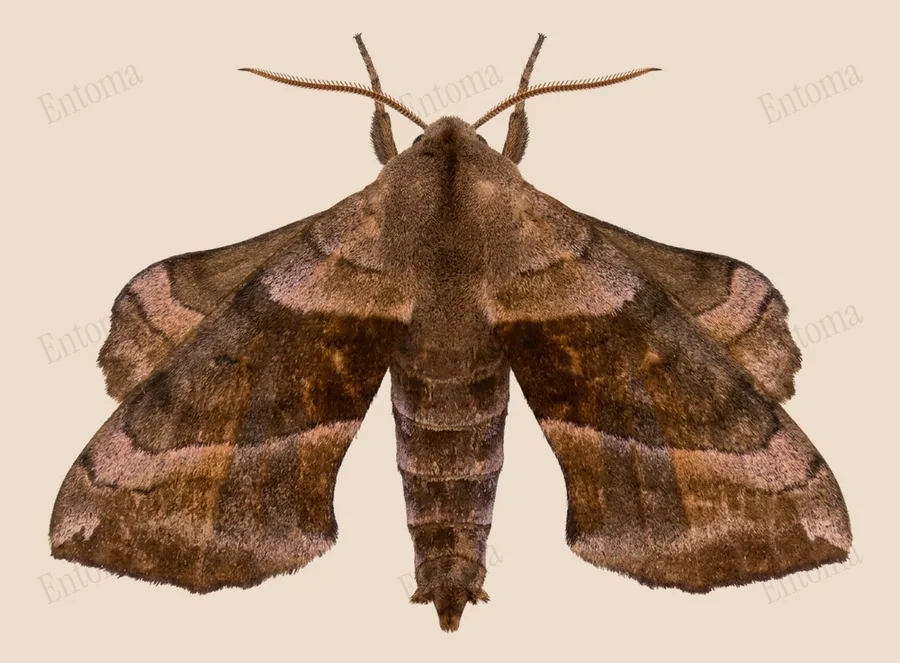
Walnut sphinx
When attacked, this moth's caterpillar forces air from its abdominal breathing pores to make a sharp whistle or squeak that makes attacking birds hesitate and often retreat.
| Where | Woodlands with walnut and hickory trees |
|---|---|
| Size | 45 to 75 mm wingspan |
| When | March to September |
The Walnut sphinx is a stout-bodied moth with a wingspan of 45 to 75 mm, its wings mottled brown and grey in a pattern that resembles a dead leaf, sometimes with faint pink shading near the tips. It rests by day with its wings folded tightly over the body, a posture typical of sphinx moths.
Caterpillars feed at night on the leaves of walnut, hickory, alder, beech, hazelnut and hop-hornbeam, resting along a leaf's midvein during the day. When disturbed, a caterpillar pushes air out through enlarged spiracles near its rear to produce a whistle or squeak, an unusual defense among moth larvae that can startle an attacking bird into pausing or letting go.
Traits
Habitat
Woodland
Colour
Brown, Grey
Active
Night
To people
Harmless to people; adults do not feed and are strongly drawn to outdoor lights at night.
Activity through the year
Often confused with
A similarly mottled brown woodland sphinx moth, but shows a blue eyespot ringed in pink on each hindwing, a mark the Walnut sphinx lacks.
Also mottled brown and of similar build, but has a small blue-and-black eyespot on each hindwing where the Walnut sphinx has only plain mottled brown.
Questions
Is the Walnut sphinx dangerous to people?
Harmless to people; adults do not feed and are strongly drawn to outdoor lights at night.
When can you see the Walnut sphinx?
The Walnut sphinx can be seen from March to September, at night.
Plate retouched from a photo by kcthetc1, CC0, iNaturalist Licence
Report a mistake in this entry
Butterflies and moths›Hawk moths›Amorpha
Last updated 2026-09-27. Every entry is checked against published sources.