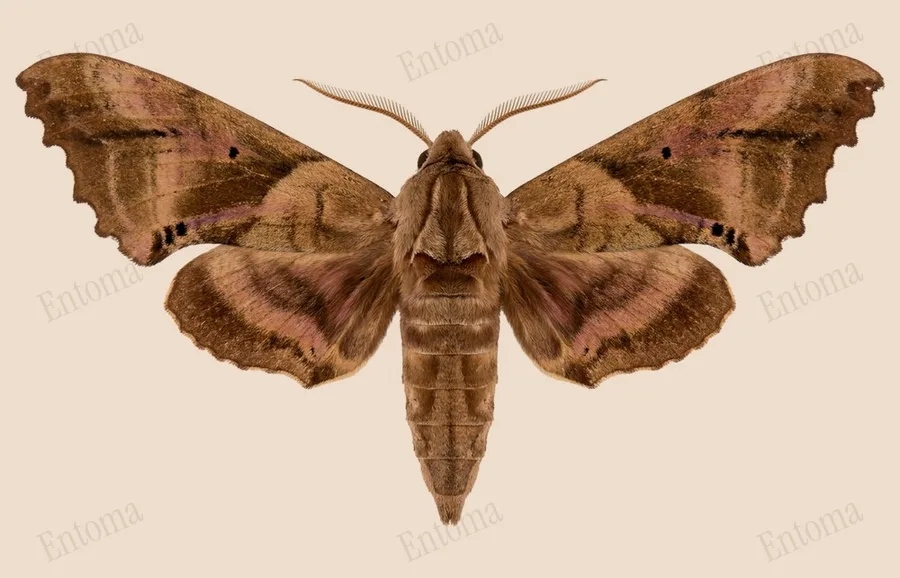
Blinded sphinx
Adult blinded sphinx moths never feed at all; they live for about a month purely to mate before dying.
| Where | Deciduous woods, shrublands and gardens |
|---|---|
| Size | 60 to 110 mm wingspan |
| When | May to September |
The blinded sphinx has mottled brown forewings with jagged, scalloped edges and a darker central patch. Each hindwing carries a broad pink patch near the body and a single blue eyespot that lacks the dark center found in a related species.
Caterpillars are green with a short rear horn and feed on willow, birch, cherry and other deciduous trees and shrubs. Adults do not feed at all, living only a few weeks after emerging in order to mate.
Traits
Habitat
Woodland
Colour
Brown, Red, Blue
Active
Night
To people
Comes to porch lights at night but does not bite or sting; harmless to people.
Activity through the year
Often confused with
Very similar in shape, but its hindwing patch is yellow rather than pink and its eyespot lacks the dark center pattern of the Blinded sphinx.
Questions
Is the Blinded sphinx dangerous to people?
Comes to porch lights at night but does not bite or sting; harmless to people.
When can you see the Blinded sphinx?
The Blinded sphinx can be seen from May to September, at night.
Plate retouched from a photo by Brett Ortler, CC BY 4.0, iNaturalist Licence
Report a mistake in this entry
Butterflies and moths›Hawk moths›Paonias
Last updated 2026-09-27. Every entry is checked against published sources.