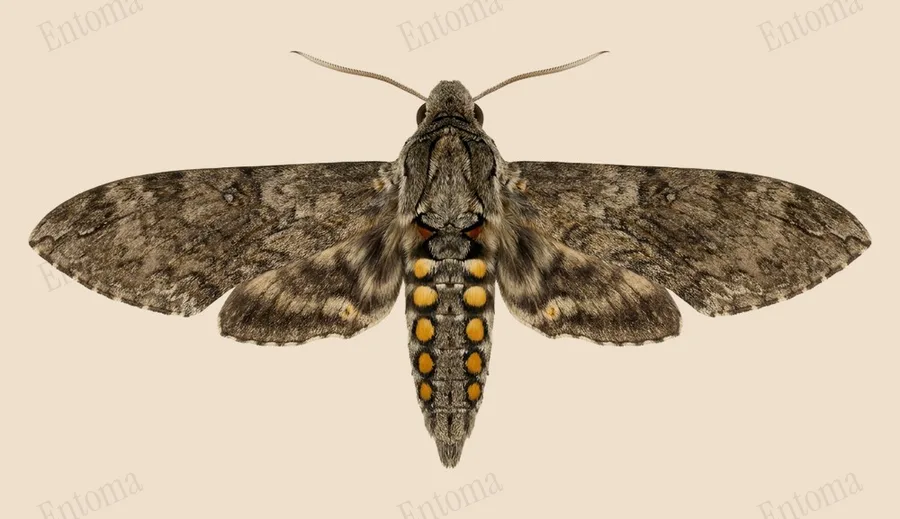
Carolina sphinx
Its caterpillar, the tobacco hornworm, can strip a tomato or tobacco plant of leaves within days before pupating underground and emerging as a large grey moth.
| Where | Farmland and gardens across the Americas |
|---|---|
| Size | 95 to 120 mm wingspan |
| When | May to October |
The Carolina sphinx has mottled grey and brown forewings and a stout grey-brown body marked along each side with six pairs of yellow spots. The hindwing shows two dark zigzag lines set close together with little white space between them.
Caterpillars feed on tomato, tobacco, and other nightshade family plants, and a well-fed larva burrows into the soil to pupate before emerging as an adult moth weeks later.
Traits
Habitat
Farmland
Colour
Brown, Grey, Yellow
Active
Night
To people
Attracted to lights and to pale, tubular flowers at dusk; not a threat to people.
Activity through the year
Often confused with
Shows five pairs of yellow abdominal spots rather than six, and its hindwing zigzag lines are bolder and more separated by white than the Carolina sphinx's.
Questions
Is the Carolina sphinx dangerous to people?
Attracted to lights and to pale, tubular flowers at dusk; not a threat to people.
When can you see the Carolina sphinx?
The Carolina sphinx can be seen from May to October, at night.
Plate retouched from a photo by Michelle W. (鍾偉瑋), CC BY 4.0, iNaturalist Licence
Report a mistake in this entry
Butterflies and moths›Hawk moths›Manduca
Last updated 2026-09-26. Every entry is checked against published sources.