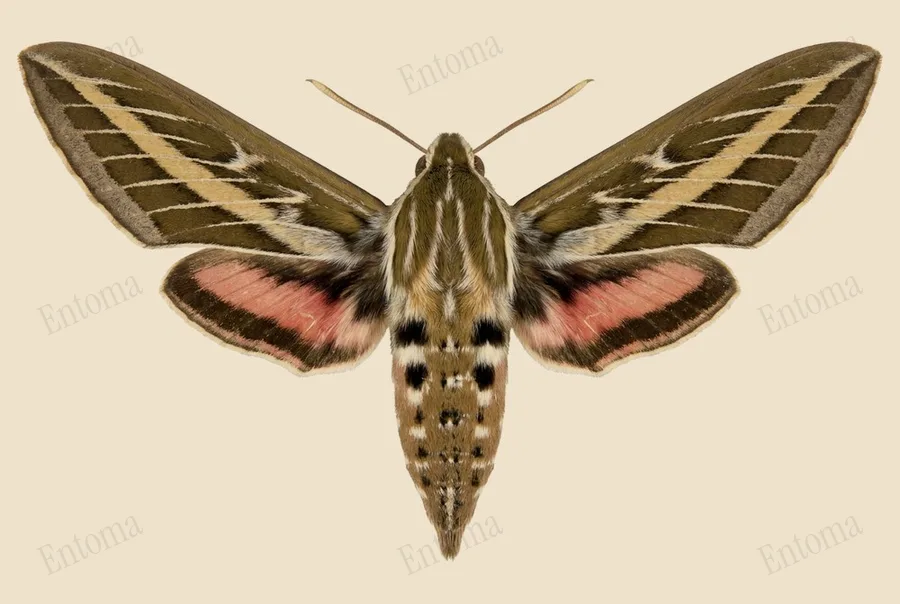
White-lined sphinx
This moth is nicknamed the hummingbird moth because it hovers at flowers using a long tongue to reach nectar bees cannot access, flying by day, dusk and night alike.
| Where | Gardens, deserts and open fields |
|---|---|
| Size | 51 to 90 mm wingspan |
| When | February to October |
Adults have brown forewings crossed by a broad tan band edged with fine white lines along the veins, and pink and black hindwings, with a wingspan that can reach about 90 mm.
Caterpillars feed on a wide range of plants, including evening primrose, grape and purslane, and come in several different color forms; adults fly from dusk into the night but are also seen visiting flowers by day.
Traits
Habitat
Garden
Colour
Brown, White
Active
Day and night
To people
Harmless to people; adults are strong fliers often mistaken for hummingbirds at dusk.
Activity through the year
Often confused with
Lacks the prominent white veins and white marked thorax that make the White-lined sphinx's forewings stand out, with a more uniformly colored, less strongly lined pattern overall.
Questions
Is the White-lined sphinx dangerous to people?
Harmless to people; adults are strong fliers often mistaken for hummingbirds at dusk.
When can you see the White-lined sphinx?
The White-lined sphinx can be seen from February to October, by day and at night.
Plate retouched from a museum specimen photo by Chuck Harp, Colorado State University, C.P. Gillette Museum of Arthropod Diversity, CC0, GBIF Licence
Report a mistake in this entry
Butterflies and moths›Hawk moths›Hyles
Last updated 2026-09-26. Every entry is checked against published sources.