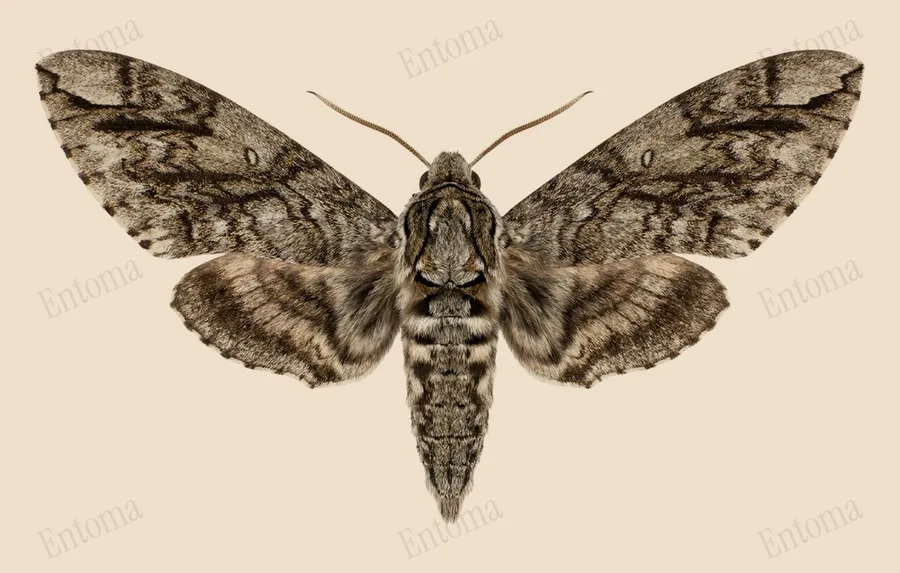
Waved sphinx
Adult Waved Sphinx moths never feed at all, living for only a week or two on fat reserves built up as caterpillars.
| Where | Woodlands, hedgerows and gardens |
|---|---|
| Size | 76 to 110 mm wingspan |
| When | April to September |
This large sphinx moth has pale gray to brown forewings crossed by wavy black lines, a pale spot near the center of each forewing, and a black and white checkered fringe along the hindwing margin.
Caterpillars feed on the leaves of ash, oak, hawthorn and privet, and the moths overwinter as pupae underground, emerging as adults that live only briefly since they do not feed.
Traits
Habitat
Woodland
Colour
Brown, Grey, White
Active
Night
To people
Harmless to people; adults do not feed and cannot bite or sting.
Activity through the year
Often confused with
Elm Sphinx forewings carry a bold white discal spot and a black and cream zigzag banding along the body, but lack the T-shaped margin marks and checkered fringe that pattern the Waved Sphinx, though the two moths overlap broadly in size.
Questions
Is the Waved sphinx dangerous to people?
Harmless to people; adults do not feed and cannot bite or sting.
When can you see the Waved sphinx?
The Waved sphinx can be seen from April to September, at night.
Plate retouched from a photo by John P Friel, CC BY 4.0, iNaturalist Licence
Report a mistake in this entry
Butterflies and moths›Hawk moths›Ceratomia
Last updated 2026-09-27. Every entry is checked against published sources.