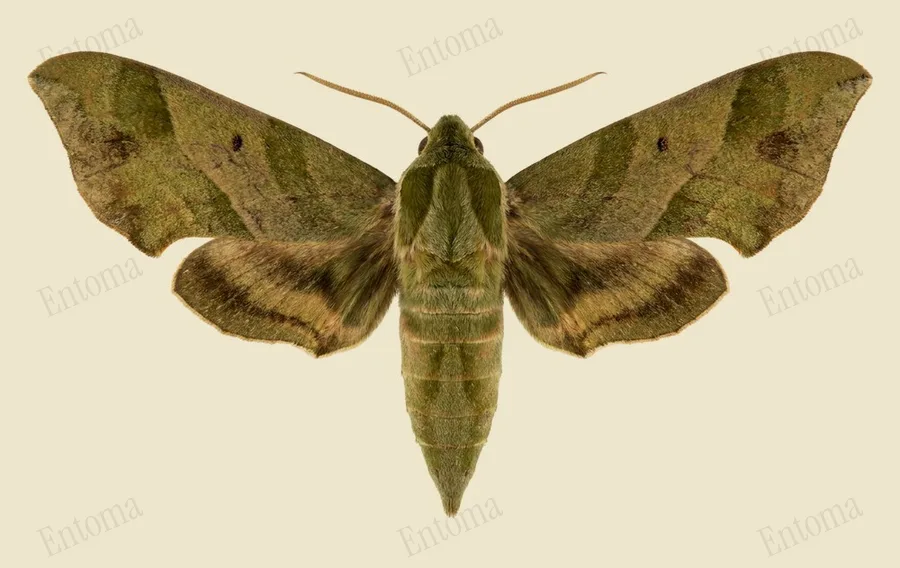
Virginia creeper sphinx
This moth hovers at flowers after dark to drink nectar, beating its wings so fast that it looks and sounds like a tiny hummingbird.
| Where | Woodland edges and vine tangles |
|---|---|
| Size | 45 to 65 mm wingspan |
| When | April to September |
The Virginia creeper sphinx is a medium-sized hawkmoth with olive-green to chocolate-brown forewings crossed by darker bands and a small dark mark at the center, and bright orange hindwings edged in brown; its wingspan runs about 45 to 65 mm.
Caterpillars feed mainly on Virginia creeper and wild grape vines, growing into plump green or brown larvae with a fleshy horn at the rear. Adults fly from spring into autumn and come readily to lights at night.
Traits
Habitat
Woodland
Colour
Green, Brown, Orange
Active
Night
To people
Attracted to light; harmless to people.
Activity through the year
Often confused with
Has bold white streaks across its green forewings and thorax that the Virginia creeper sphinx lacks, and its caterpillars feed on hydrangea and buttonbush near water rather than on grape vines.
Questions
Is the Virginia creeper sphinx dangerous to people?
Attracted to light; harmless to people.
When can you see the Virginia creeper sphinx?
The Virginia creeper sphinx can be seen from April to September, at night.
Plate retouched from a photo by Annika Lindqvist, CC BY 4.0, iNaturalist Licence
Report a mistake in this entry
Butterflies and moths›Hawk moths›Darapsa
Last updated 2026-09-27. Every entry is checked against published sources.