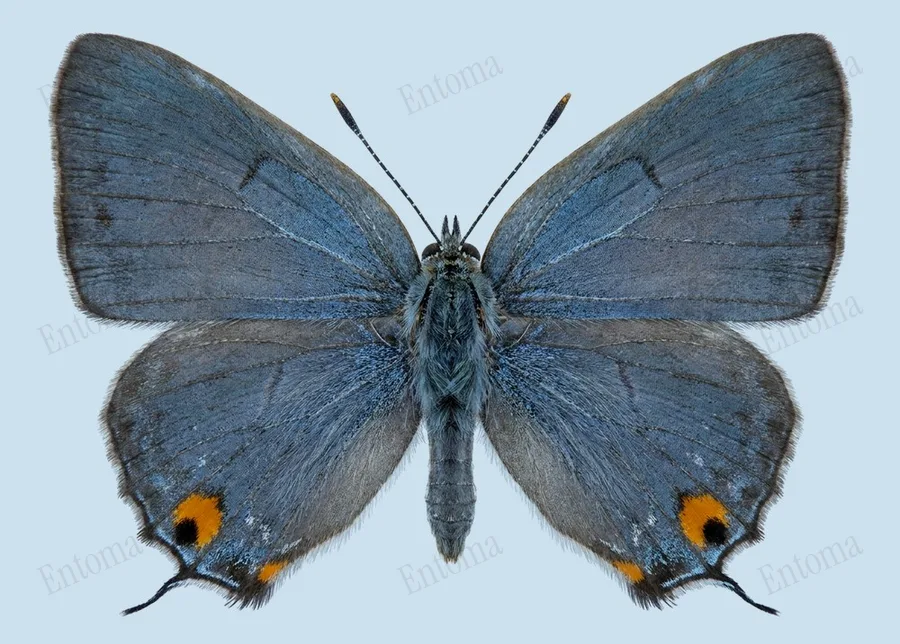
Gray hairstreak
Its hindwing tails twitch back and forth at rest, drawing a predator's strike toward a false head instead of the real one.
| Where | Open, disturbed ground and gardens |
|---|---|
| Size | 22 to 35 mm wingspan |
| When | March to October |
The Gray hairstreak shows true gray on the underside crossed by fine black and white lines, with an orange-capped black spot near a pair of thin, tail-like extensions on each hindwing; males are gray above and females blue-gray.
Caterpillars feed on flowers and seed pods from an unusually wide range of plants, especially in the pea and mallow families, and multiple broods fly through the warmer months across nearly all of the continental range.
Traits
Habitat
Farmland
Colour
Grey, Orange
Active
Day
To people
Does not sting or bite; visits a wide range of garden flowers for nectar.
Activity through the year
Often confused with
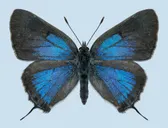
Similar size and tailed hindwings, but the Red-banded hairstreak shows a wide orange-red band on the underside positioned close to the body, while the Gray hairstreak's underside line stays white with only a narrow red-orange edge.
Questions
Is the Gray hairstreak dangerous to people?
Does not sting or bite; visits a wide range of garden flowers for nectar.
When can you see the Gray hairstreak?
The Gray hairstreak can be seen from March to October, by day.
Plate retouched from a museum specimen photo by San Diego Natural History Museum, CC0, GBIF Licence
Report a mistake in this entry
Butterflies and moths›Blues and coppers›Strymon
Last updated 2026-09-26. Every entry is checked against published sources.