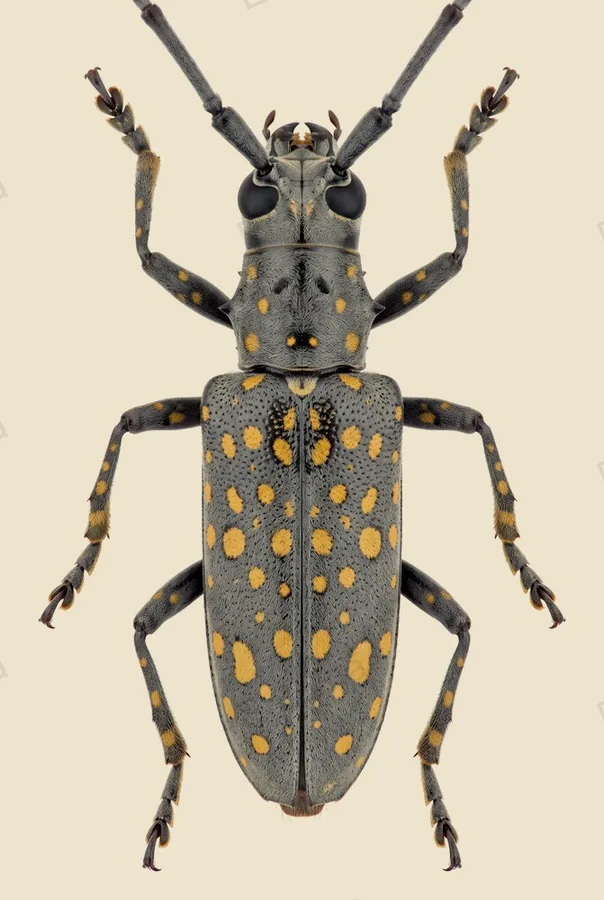
Yellow-spotted longicorn beetle
The yellow-spotted longicorn beetle is a wood borer whose larvae tunnel inside the branches and trunks of fig and mulberry trees while the adults feed on young leaves.
| Where | Fig and mulberry trees |
|---|---|
| Size | 15 to 30 mm body length |
| When | April to November |
A long-horned beetle about 15 to 30 mm long. The body is dark, grey black to dark brown, and the wing covers carry large and small yellow spots. The pattern varies a great deal between populations.
Females lay about 300 eggs under the bark. The young larvae feed just under the bark and later bore deep into the wood. The beetle spends the winter as a larva, and adults appear in early summer, from June to July, and again in autumn, from September to October.
It is a pest of fig and mulberry. The larvae tunnel for one to two years inside branches and trunks, which weakens the tree and can kill it when many larvae are present. Adults add to the damage by feeding on young leaves and on bark. Damage shows as sawdust like droppings pushed out of holes and cracked bark on branches.
Traits
Habitat
Farmland
Colour
Black, Yellow
Active
Day
To people
It is of concern mainly to growers of fig and mulberry, who watch for sawdust like droppings pushed out of branches as the sign of tunnelling larvae.
Activity through the year
Often confused with
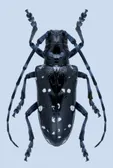
Has shiny black wing covers marked with 10 to 12 white round spots, where this species has large and small yellow spots.
Questions
Is the Yellow-spotted longicorn beetle dangerous to people?
It is of concern mainly to growers of fig and mulberry, who watch for sawdust like droppings pushed out of branches as the sign of tunnelling larvae.
When can you see the Yellow-spotted longicorn beetle?
The Yellow-spotted longicorn beetle can be seen from April to November, by day.
Sources pref.miyagi.jppref.shimane.lg.jpgd.eppo.intriviste.unimi.itcaps.ceris.purdue.eduedis.ifas.ufl.edu
Plate retouched from a photo by Takaaki Hattori, CC BY 4.0, iNaturalist Licence
Report a mistake in this entry
Beetles›Longhorn beetles›Psacothea
Last updated 2026-10-17. Every entry is checked against published sources.