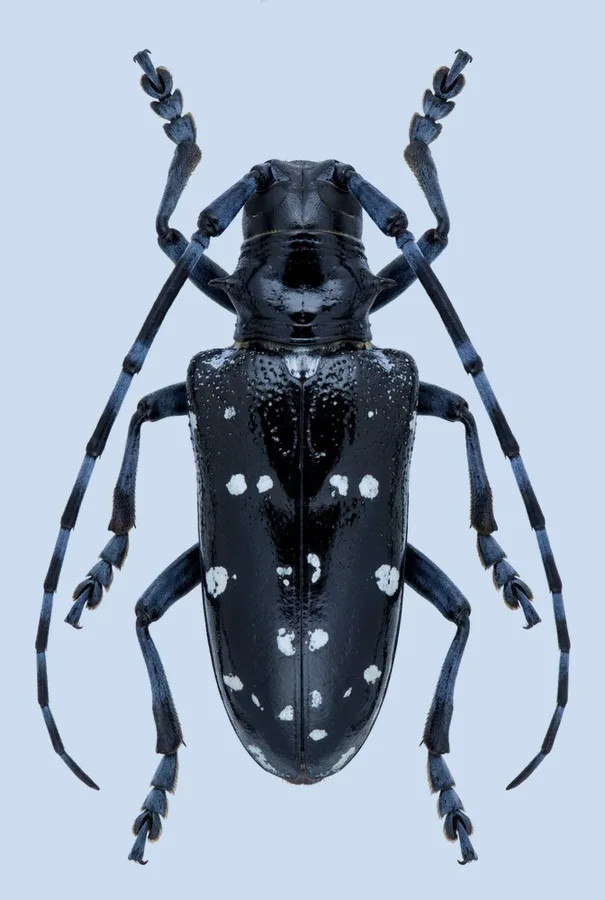
Citrus longhorn beetle
Females of this beetle chew a small slit into bark and lay a single egg beneath it, leaving oval scars that help foresters detect new infestations early.
| Where | Citrus orchards and woodlands across East Asia |
|---|---|
| Size | 20 to 40 mm body length |
| When | June to September |
The citrus longhorn beetle is a glossy black beetle 20 to 40 millimetres long, its elytra scattered with irregular white spots. Long antennae banded in black and white extend well past the body, a feature typical of longhorn beetles.
Larvae bore into the roots and lower trunk of citrus and other broadleaf trees, often killing young trees over a few seasons, while females chew shallow pits in the bark to lay their eggs. Native to China, Korea, and Japan, it remains a serious orchard and quarantine pest across East Asia.
Traits
Habitat
Farmland
Colour
Black, White
Active
Day
To people
Harmless to people; adults may nibble bark and twigs but do not sting or bite defensively.
Activity through the year
Often confused with
Distinctly larger at over 50 millimetres, with a matte greyish-brown body and a broad cream-white stripe running from behind each eye to the tail, unlike the smaller glossy black, white-spotted citrus longhorn beetle.
Questions
Is the Citrus longhorn beetle dangerous to people?
Harmless to people; adults may nibble bark and twigs but do not sting or bite defensively.
When can you see the Citrus longhorn beetle?
The Citrus longhorn beetle can be seen from June to September, by day.
Plate retouched from a photo by りなべる, CC BY 4.0, iNaturalist Licence
Report a mistake in this entry
Beetles›Longhorn beetles›Anoplophora
Last updated 2026-09-27. Every entry is checked against published sources.