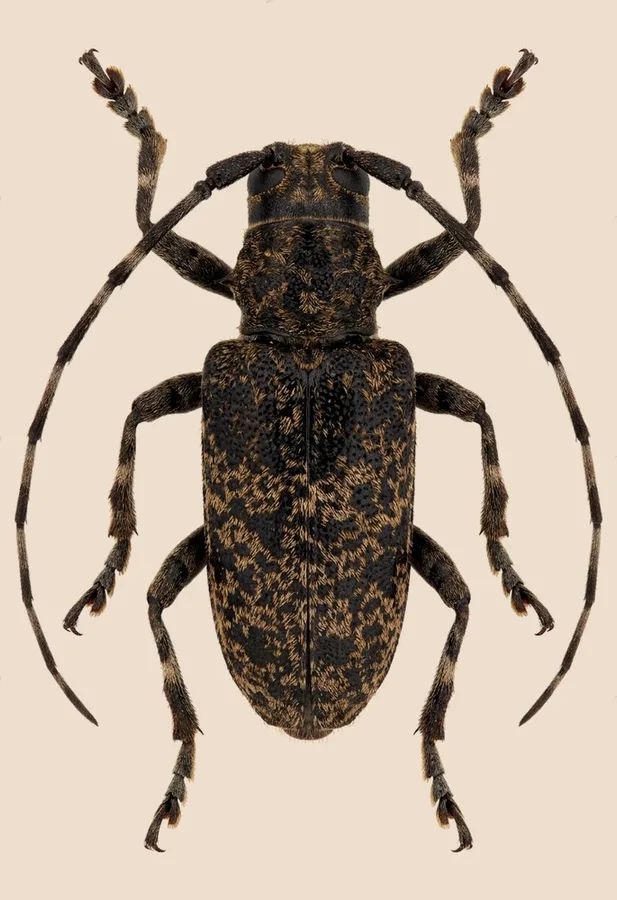
Oak longicorn beetle
This oak longhorn beetle carries a pair of hairy tubercles and a bright red underside, and its larvae damage shiitake mushroom logs.
| Where | Oak and beech forests, East Asia |
|---|---|
| Size | 15 to 30 mm body length |
| When | February and April to October |
The Oak longicorn beetle is dark brown to blackish, covered in fine reddish brown hairs, with a pair of dark haired tubercles at the base of the wing cases and a red underside that gives it its common Japanese name.
Adults emerge in autumn and overwinter before becoming active again in spring, and the grubs tunnel into oak, beech and chestnut wood, including cut logs used to grow shiitake mushrooms, where they can cause serious damage.
Traits
Habitat
Woodland
Colour
Black, Brown, Red
Active
Day
To people
Does not bite or sting; the larvae are a costly pest of shiitake mushroom logs.
Activity through the year
Often confused with
A smaller, flightless longhorn beetle, about 12 to 18 mm long, with forward pointing humps on the pronotum rather than the pair of hairy tubercles at the base of the wing cases in the Oak longicorn beetle.
Questions
Is the Oak longicorn beetle dangerous to people?
Does not bite or sting; the larvae are a costly pest of shiitake mushroom logs.
When can you see the Oak longicorn beetle?
The Oak longicorn beetle can be seen from February and April to October, by day.
Plate retouched from a photo by forfoster, CC0, iNaturalist Licence
Report a mistake in this entry
Beetles›Longhorn beetles›Moechotypa
Last updated 2026-09-27. Every entry is checked against published sources.