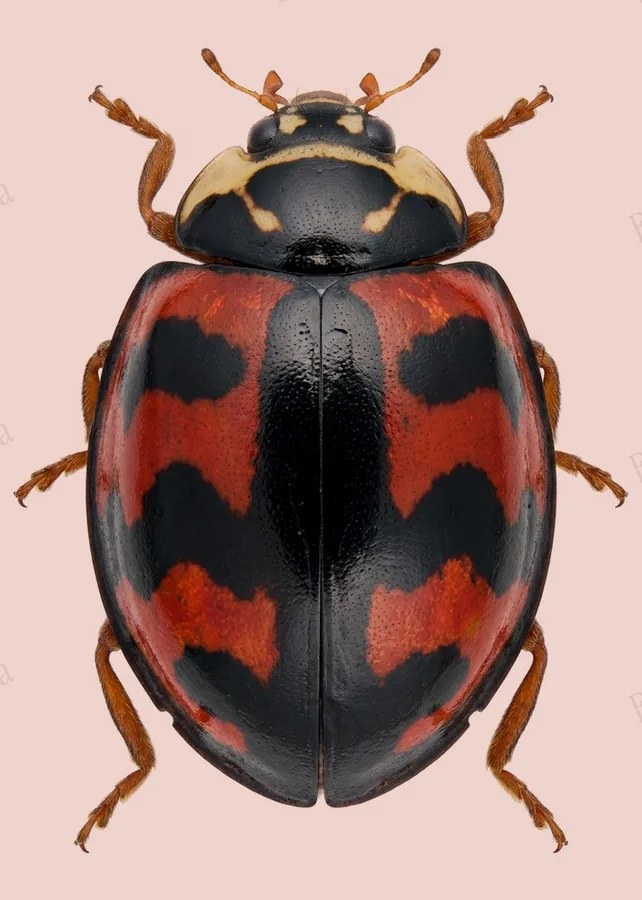
Six-spotted zigzag ladybird
This ladybird attacks such a wide range of soft-bodied pests, aphids, whiteflies, thrips, scale insects and mealybugs, that farmers use it for biological pest control across Asia.
| Where | Crop fields, gardens and hedgerows |
|---|---|
| Size | 3.0 to 5.5 mm body length |
| When | February to October |
Adults are small, rounded and shiny, with a yellow to orange body crossed by a variable black pattern that can range from a few small spots to broad black bands. More than one color form can occur within the same population.
Both larvae and adults hunt aphids, whiteflies, thrips, scale insects and mealybugs on crops and garden plants, making the species a valued natural pest control agent across South, Southeast and East Asia.
Traits
Habitat
Farmland
Colour
Yellow, Black
Active
Day
To people
Does not bite or sting people and is welcomed by farmers as a predator of crop pests.
Activity through the year
Often confused with
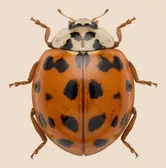
Has a white pronotum patterned in black, and its elytra pattern ranges from many small spots to almost solid black, unlike the zigzag pattern of the Six-spotted zigzag ladybird.
Questions
Is the Six-spotted zigzag ladybird dangerous to people?
Does not bite or sting people and is welcomed by farmers as a predator of crop pests.
When can you see the Six-spotted zigzag ladybird?
The Six-spotted zigzag ladybird can be seen from February to October, by day.
Plate retouched from a museum specimen photo by Naturalis Biodiversity Center, CC0, GBIF Licence
Report a mistake in this entry
Last updated 2026-09-27. Every entry is checked against published sources.