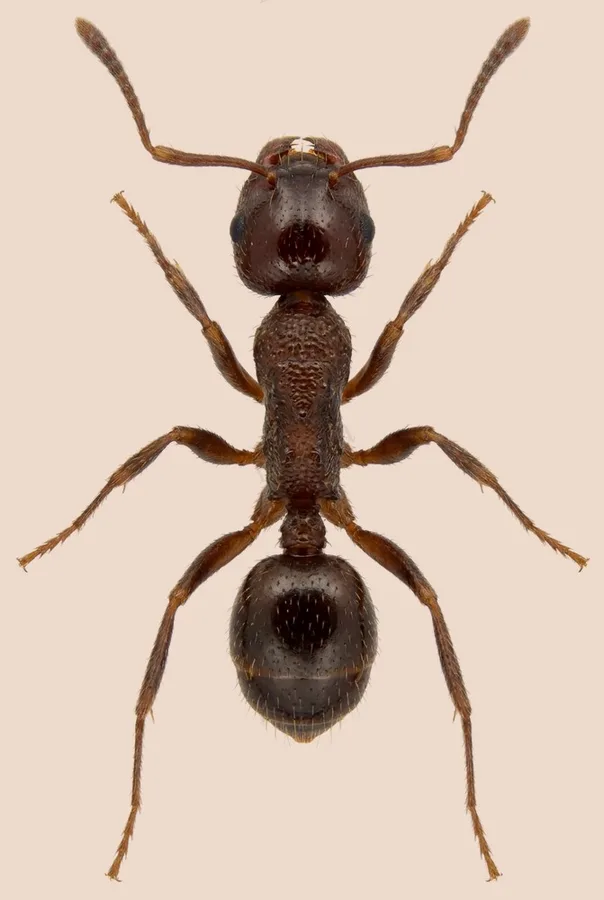
Japanese queenless ant
Colonies of this ant have no queen at all; ordinary workers lay the unfertilised eggs that keep the whole nest going generation after generation.
| Where | Forest floor and gardens, Japan |
|---|---|
| Size | 2.5 to 3.5 mm body length |
| When | April to October |
A small ant with a tea brown head and thorax and a glossier, darker brown gaster, the head and thorax finely sculpted with a net like, reticulate texture that gives related species their common name.
Workers shelter in loose groups under stones and in rotting wood rather than building a fixed nest, and the colony has no true queen, since workers themselves lay the eggs that produce new workers.
Traits
Habitat
Woodland
Colour
Brown
Active
Day
To people
Mild
Workers carry a tiny sting but rarely use it against people, and no human injuries have been reported.
Activity through the year
Often confused with
A similarly small litter dwelling ant with a smoother, glossier head and thorax, lacking the net like reticulate sculpture typical of this species.
Questions
Is the Japanese queenless ant dangerous to people?
Mild. Workers carry a tiny sting but rarely use it against people, and no human injuries have been reported.
When can you see the Japanese queenless ant?
The Japanese queenless ant can be seen from April to October, by day.
Plate retouched from a photo by りなべる, CC BY 4.0, iNaturalist Licence
Report a mistake in this entry
Bees, wasps and ants›Ants›Pristomyrmex
Last updated 2026-09-27. Every entry is checked against published sources.