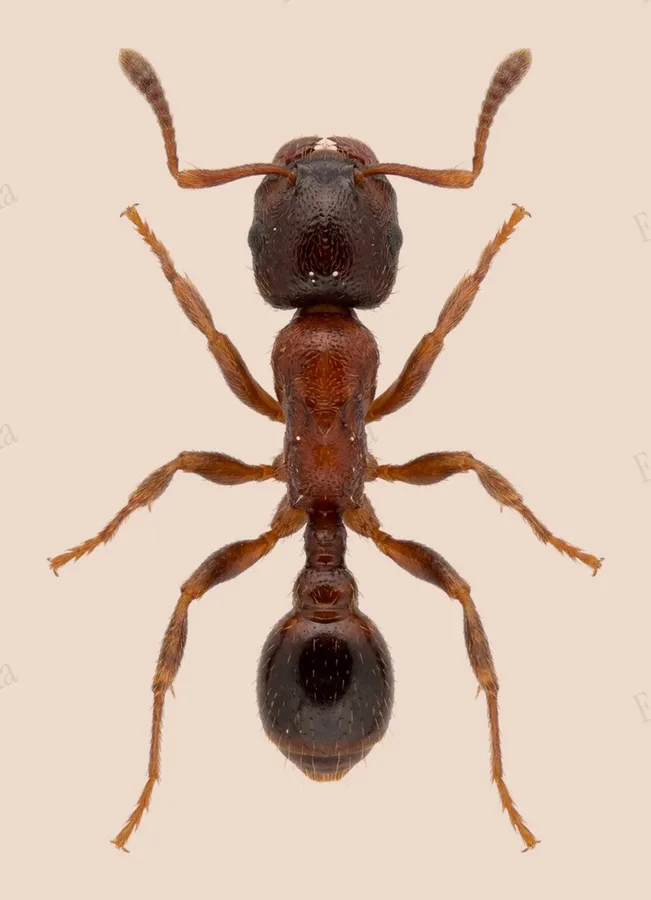
Japanese pavement ant
Colonies of this ant can hold several hundred queens at once, unlike its European look-alike, which normally has just one queen per nest.
| Where | Open sunny ground in cities and grassland |
|---|---|
| Size | 2.5 to 2.8 mm body length |
| When | April to October |
The Japanese pavement ant is a small, blackish brown ant almost identical to the pavement ants introduced from Europe, but slightly smaller and with a longer spine at the back of the thorax. Colonies can hold several hundred queens, unlike the single-queen nests of its European look-alike.
It nests in open, sunny ground in cities, suburbs and grassland, feeding on both live and dead insects and tending aphids for their sugary honeydew. Workers forage in trails on paths, walls and bare soil.
Traits
Habitat
Towns
Colour
Brown, Black
Active
Day
To people
Mild
Workers, all female, can sting if the nest is disturbed, but the sting is mild and rarely breaks human skin.
Activity through the year
Often confused with
Has a gaster distinctly darker than its head and thorax, unlike the more evenly blackish brown body of the Japanese pavement ant.
Questions
Is the Japanese pavement ant dangerous to people?
Mild. Workers, all female, can sting if the nest is disturbed, but the sting is mild and rarely breaks human skin.
When can you see the Japanese pavement ant?
The Japanese pavement ant can be seen from April to October, by day.
Plate retouched from a photo by りなべる, CC BY 4.0, iNaturalist Licence
Report a mistake in this entry
Bees, wasps and ants›Ants›Tetramorium
Last updated 2026-09-27. Every entry is checked against published sources.