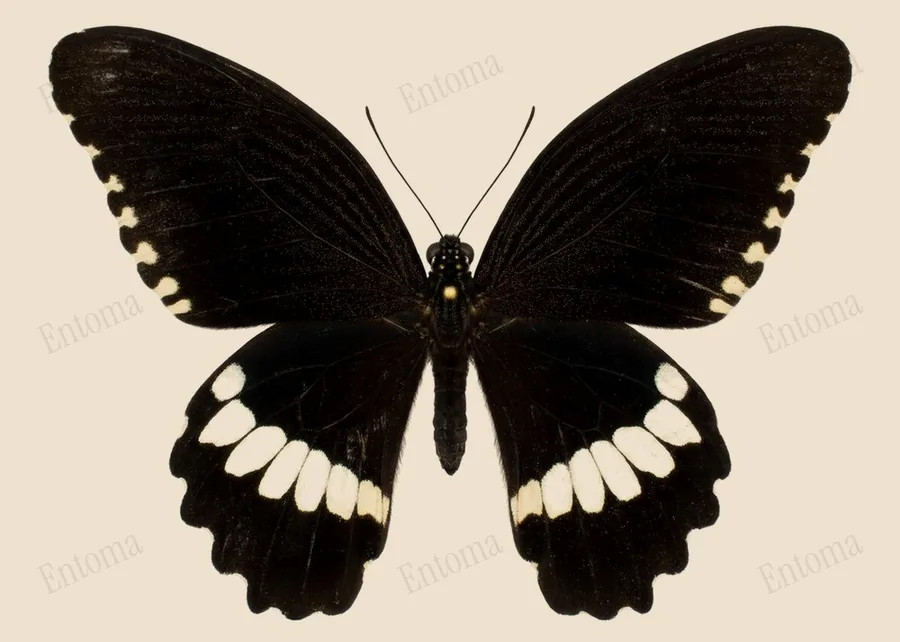
Common mormon
Female Common Mormons appear in three different wing patterns, two of which closely copy red bodied swallowtails that are unpleasant for birds to eat.
| Where | Forests, gardens and citrus orchards |
|---|---|
| Size | 70 to 115 mm wingspan |
| When | March to November |
The Common Mormon is a black swallowtail without tails on the hindwings. Males have a single form with white spots across the forewing and a complete white band on the hindwing, while females occur in three forms, one resembling the male and two mimicking red bodied swallowtails that share the same forests.
Caterpillars feed on citrus and other rue family plants and are considered a pest of cultivated lime and orange trees in parts of its range. Adults fly through most of the year, gathering at damp ground and flowering shrubs in gardens and open woodland.
Traits
Habitat
Garden
Colour
Black, Yellow, Red
Active
Day
To people
Harmless to people; the caterpillars are a minor pest of citrus trees.
Activity through the year
Often confused with

Has a solid red body rather than the black body carried by both sexes of the Common Mormon, including its red bodied mimic form.

Also has a red body and red hindwing spots, unlike the Common Mormon whose body stays black in every form and colour pattern.
Questions
Is the Common mormon dangerous to people?
Harmless to people; the caterpillars are a minor pest of citrus trees.
When can you see the Common mormon?
The Common mormon can be seen from March to November, by day.
Plate retouched from a museum specimen photo by Swiss Natural History Collections - SwissNatColl, CC BY 4.0, GBIF Licence
Report a mistake in this entry
Butterflies and moths›Swallowtails›Papilio
Last updated 2026-09-27. Every entry is checked against published sources.