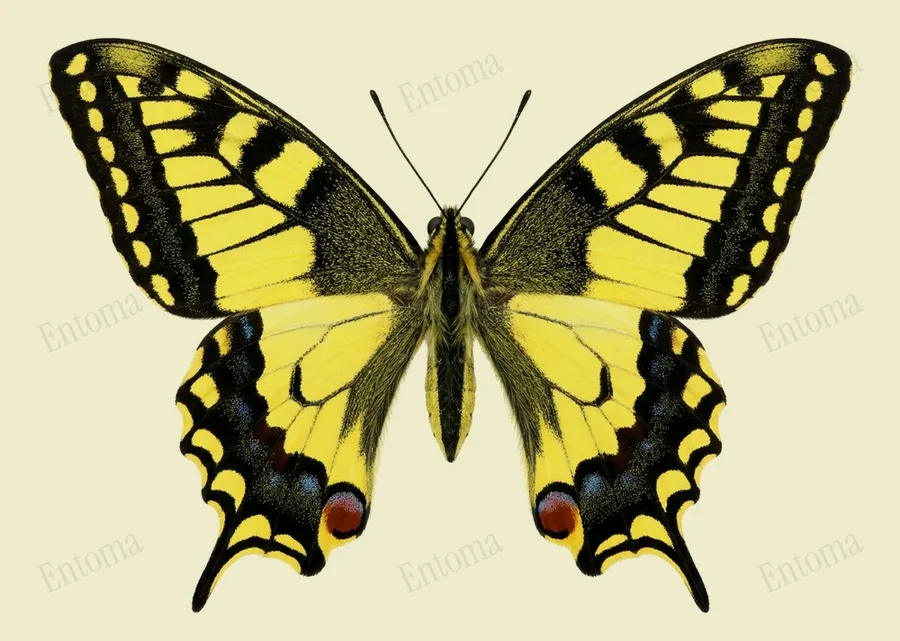
Japanese common swallowtail
Spring-generation adults can be barely three quarters the size of summer-generation adults, and the species now flies from coastal farmland to alpine slopes.
| Where | Farmland and grassland across East Asia |
|---|---|
| Size | 70 to 120 mm wingspan |
| When | April to October |
The wings are a bright yellow ground crossed by fine black lines and bands, looking more uniformly yellow than the more heavily black-striped Asian swallowtail with which it shares much of its range.
Caterpillars feed on umbellifers such as wild carrot, fennel and related farmland and garden plants, and like other swallowtails can push out a hidden forked orange gland behind the head that releases a strong smell if disturbed.
Traits
Habitat
Farmland
Colour
Yellow, Black
Active
Day
To people
Harmless to people; caterpillars release a strong smell from a hidden orange gland if disturbed.
Activity through the year
Often confused with
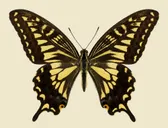
Shows more extensive black striping across a yellow ground, where the Japanese common swallowtail looks more uniformly yellow with black concentrated at the base and margins.
Questions
Is the Japanese common swallowtail dangerous to people?
Harmless to people; caterpillars release a strong smell from a hidden orange gland if disturbed.
When can you see the Japanese common swallowtail?
The Japanese common swallowtail can be seen from April to October, by day.
Plate retouched from a museum specimen photo by University of Oslo, CC BY 4.0, GBIF Licence
Report a mistake in this entry
Butterflies and moths›Swallowtails›Papilio
Last updated 2026-09-27. Every entry is checked against published sources.