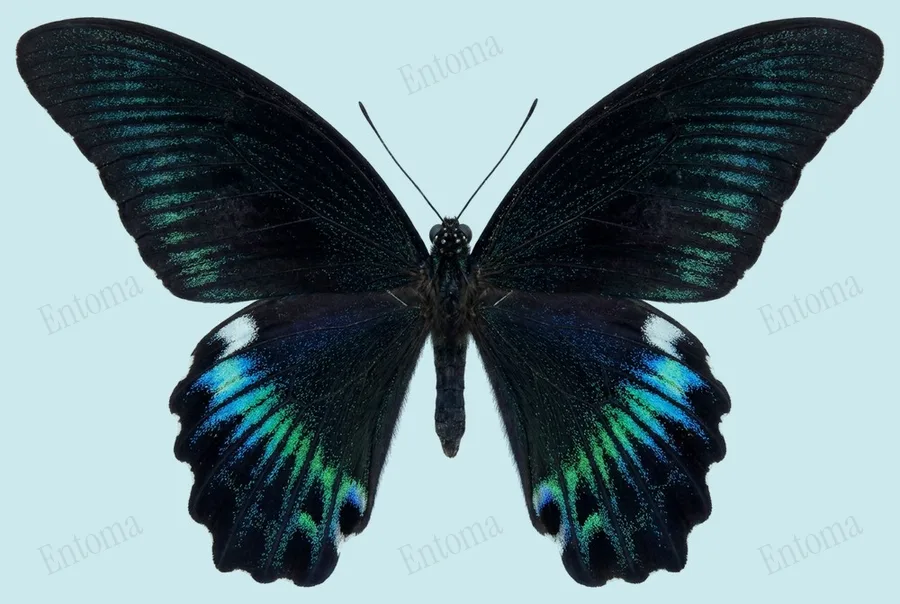
Spangle swallowtail
Female Spangle swallowtails show more red spots on the underside of their wings than males, one of the few visible differences between the otherwise similar-looking sexes.
| Where | Forests across South, East and Southeast Asia |
|---|---|
| Size | 100 to 140 mm wingspan |
| When | March to November |
The Spangle swallowtail is a large, velvety blue-black swallowtail, with females showing more blue scaling and red spots on the underside than males. The hindwing carries a broad pale streak and a wavy outer edge.
Caterpillars feed on citrus and other rutaceous trees, and pupae turn either green or brown depending on where they attach. Adults fly through forests from spring into autumn across a wide range of East, South and Southeast Asia.
Traits
Habitat
Woodland
Colour
Black, Blue, Red
Active
Day
To people
Visits citrus groves and gardens for nectar; harmless to people.
Activity through the year
Often confused with
Papilio macilentus has long, slender tails on the hindwings and narrower, more elongated wings, unlike the untailed hindwing of the Spangle swallowtail.
Questions
Is the Spangle swallowtail dangerous to people?
Visits citrus groves and gardens for nectar; harmless to people.
When can you see the Spangle swallowtail?
The Spangle swallowtail can be seen from March to November, by day.
Plate retouched from a museum specimen photo by Virginia Tech, Department of Entomology, Virginia Tech Insect Collection, CC0, GBIF Licence
Report a mistake in this entry
Butterflies and moths›Swallowtails›Papilio
Last updated 2026-09-27. Every entry is checked against published sources.