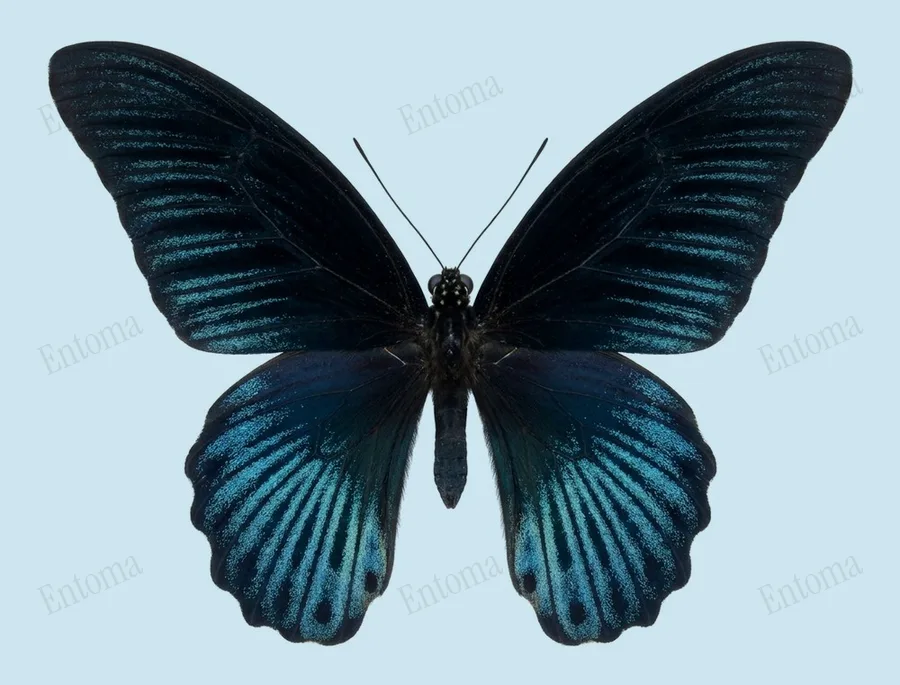
Great mormon
Female Great Mormons appear in as many as two dozen named forms, some patterned to copy other, unpalatable swallowtails rather than resembling their own black and blue green males.
| Where | Forest edges, streams and gardens |
|---|---|
| Size | 110 to 135 mm wingspan |
| When | March to December |
Males are black dusted with bluish green and lack tails, with a red patch near the inner hind wing and red at the wing bases beneath, while females are strikingly variable and some forms carry tails.
Caterpillars feed on citrus family plants such as citrus and pomelo, and adults fly fast at treetop height along forest edges, visiting flowers in parks and gardens as well as wilder ground.
Traits
Habitat
Woodland
Colour
Black, Red, Blue
Active
Day
To people
Adults visit flowers in parks and gardens by day; harmless to people.
Activity through the year
Often confused with
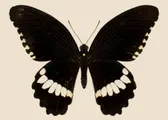
Smaller at 90 to 100 mm wingspan, with mimicking female forms that copy the red bodied Common rose rather than the blue Blue Mormon copied by some Great Mormon females.
Questions
Is the Great mormon dangerous to people?
Adults visit flowers in parks and gardens by day; harmless to people.
When can you see the Great mormon?
The Great mormon can be seen from March to December, by day.
Plate retouched from a museum specimen photo by Swiss Natural History Collections - SwissNatColl, CC BY 4.0, GBIF Licence
Report a mistake in this entry
Butterflies and moths›Swallowtails›Papilio
Last updated 2026-09-27. Every entry is checked against published sources.