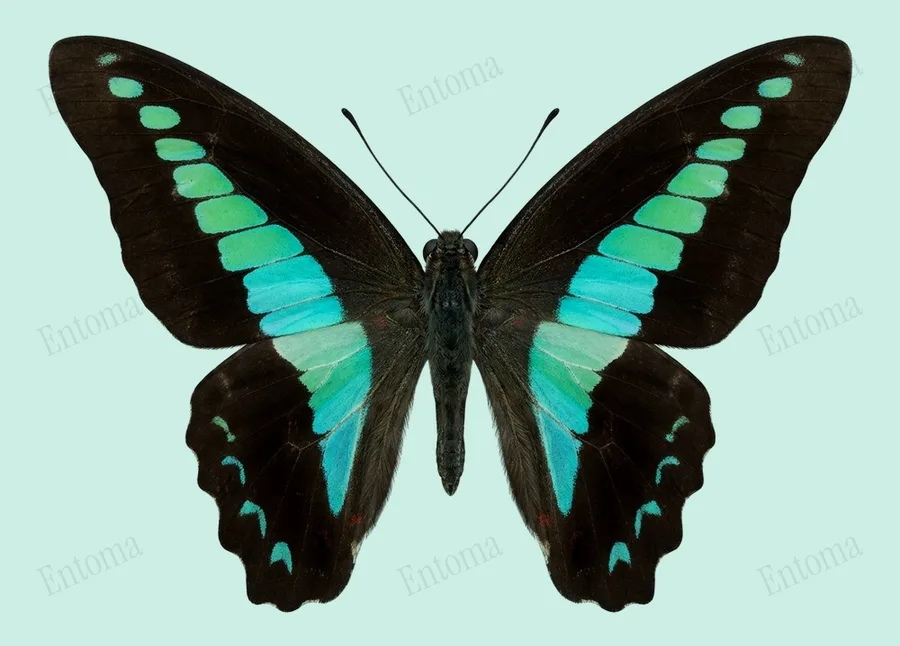
Common bluebottle
Its fast, erratic flight around trees and flowers makes it one of the hardest East Asian swallowtails to follow with the eye or photograph.
| Where | Riversides and forest edges |
|---|---|
| Size | 55 to 75 mm wingspan |
| When | March to October |
This swallowtail has black wings crossed by a broad band of pale blue green triangular spots, with a patch of red near the body on the underside of the hindwing.
Caterpillars feed on camphor laurel leaves and are green with yellow stripes that mimic the host leaves, and adults gather at wet mud and puddles to drink minerals.
Traits
Habitat
Woodland
Colour
Black, Blue, Green
Active
Day
To people
Harmless to people; adults are fast fliers that rarely stay still long enough to be handled.
Activity through the year
Often confused with
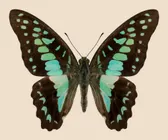
Similar black wings crossed by a pale blue band, but the band is made of separate rounded spots rather than the Common bluebottle's continuous triangular band.
Questions
Is the Common bluebottle dangerous to people?
Harmless to people; adults are fast fliers that rarely stay still long enough to be handled.
When can you see the Common bluebottle?
The Common bluebottle can be seen from March to October, by day.
Plate retouched from a museum specimen photo by Frans Slieker, Natural History Museum Rotterdam, CC BY 4.0, GBIF Licence
Report a mistake in this entry
Butterflies and moths›Swallowtails›Graphium
Last updated 2026-09-27. Every entry is checked against published sources.