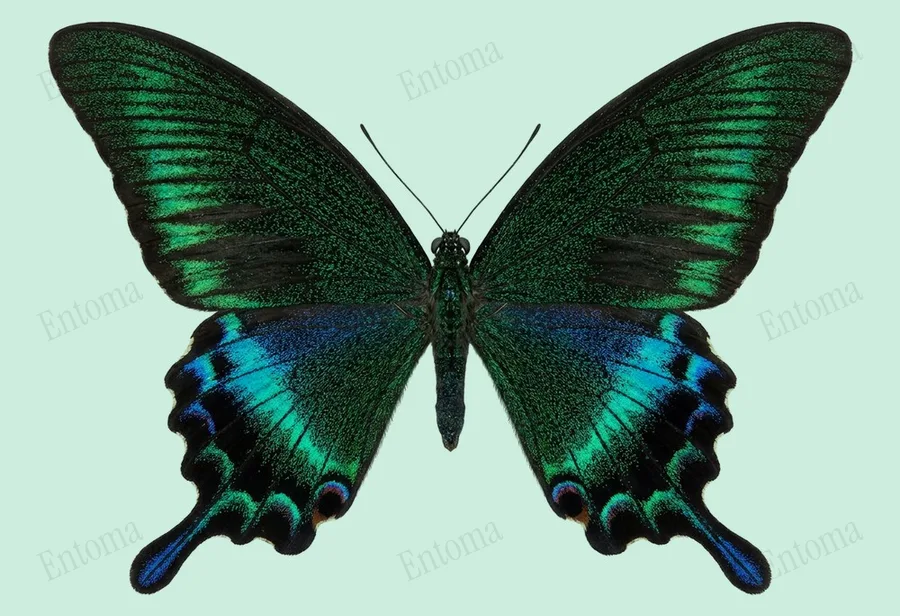
Japanese peacock swallowtail
Spring generation adults of this swallowtail can be barely half the size of summer generation adults, one of the largest seasonal size shifts among regional swallowtails.
| Where | Mountain forest across Korea, Japan and China |
|---|---|
| Size | 40 to 120 mm wingspan, smaller in spring |
| When | April to September |
The Japanese peacock swallowtail is a black swallowtail with a blue green iridescent sheen across the wings, weaker and darker than the closely related Maack's swallowtail, and usually found at lower elevation than that species.
It flies in two very different looking generations, a smaller spring form and a much larger summer form. Adults are seen in forest along mountain slopes and valley edges.
Traits
Habitat
Woodland
Colour
Black, Blue, Green
Active
Day
To people
Harmless to people; does not bite or sting.
Activity through the year
Often confused with
Shows a much stronger blue green iridescence and more vivid red hindwing spots than the darker, less shiny Japanese peacock swallowtail.
Questions
Is the Japanese peacock swallowtail dangerous to people?
Harmless to people; does not bite or sting.
When can you see the Japanese peacock swallowtail?
The Japanese peacock swallowtail can be seen from April to September, by day.
Plate retouched from a museum specimen photo by National Museum of Nature and Science, Japan, CC BY 4.0, GBIF Licence
Report a mistake in this entry
Butterflies and moths›Swallowtails›Papilio
Last updated 2026-09-27. Every entry is checked against published sources.