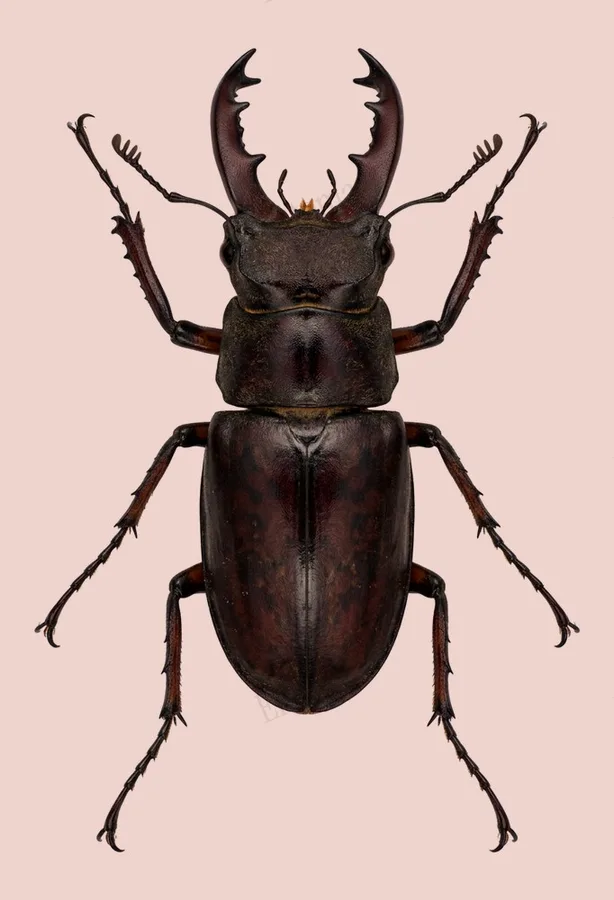
Miyama stag beetle
Rival males of this stag beetle wrestle by slipping their forked mandibles beneath each other, then flip their opponent off a branch, rarely causing real injury.
| Where | Mountain oak forests across East Asia |
|---|---|
| Size | 32 to 78 mm body length |
| When | June to September |
The Miyama stag beetle is a large beetle with a dark brown body carrying a faint bronze or greenish sheen. Males carry long, branching, antler-like mandibles lined with small teeth and can reach nearly 80 millimetres, while females are much smaller with short jaws.
Larvae take several years to develop inside rotting wood in oak-dominated mountain forests, and adults emerge in summer to feed on tree sap, often coming to lights at night. It ranges across Japan, Korea, China, the Russian Far East, and Taiwan.
Traits
Habitat
Woodland
Colour
Brown, Metallic
Active
Night
To people
Harmless to people; does not sting, and its mandibles rarely break skin even when handled.
Activity through the year
Often confused with
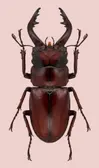
Males carry gently curved, saber-like mandibles rather than the straight, deeply forked mandibles of the Miyama stag beetle, and the body is a smoother red-brown rather than bronze-tinged.
Questions
Is the Miyama stag beetle dangerous to people?
Harmless to people; does not sting, and its mandibles rarely break skin even when handled.
When can you see the Miyama stag beetle?
The Miyama stag beetle can be seen from June to September, at night.
Plate retouched from a photo by りなべる, CC BY 4.0, iNaturalist Licence
Report a mistake in this entry
Last updated 2026-09-27. Every entry is checked against published sources.