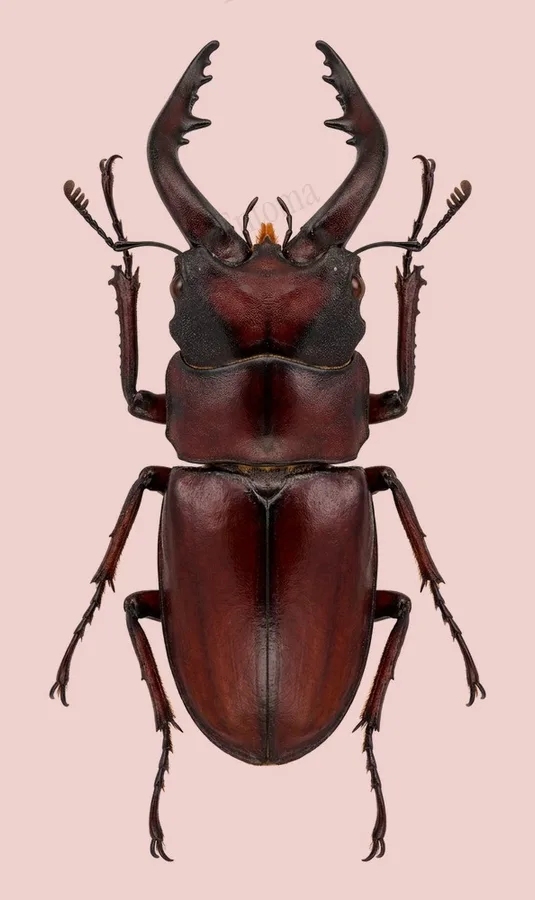
Japanese stag beetle
Rival males wrestle with long, saw-toothed mandibles, trying to flip each other off narrow sap-feeding sites on oak trunks.
| Where | Broadleaf forests across Japan and Korea |
|---|---|
| Size | 20 to 77 mm body length |
| When | June to September |
The Japanese stag beetle is reddish brown to black and glossy, with males carrying enlarged, saw-toothed mandibles that vary from strongly curved to nearly straight; body length ranges from about 20 mm in small females to over 75 mm in the largest males. Females are smaller, with short, simple jaws.
Adults gather at sap flows on oaks such as konara and sawtooth oak from early summer to autumn, feeding at night and coming readily to lights, while larvae spend one to three years developing inside rotting wood.
Traits
Habitat
Woodland
Colour
Brown, Black
Active
Day and night
To people
Harmless to people; the large mandibles are used against rival males, not in defence against humans.
Activity through the year
Often confused with
Overlaps broadly in size but has fewer, larger teeth set toward the base of the mandible and a forked mandible tip, rather than the even row of saw-like teeth running along the whole jaw in the Japanese stag beetle.
Questions
Is the Japanese stag beetle dangerous to people?
Harmless to people; the large mandibles are used against rival males, not in defence against humans.
When can you see the Japanese stag beetle?
The Japanese stag beetle can be seen from June to September, by day and at night.
Plate retouched from a museum specimen photo by Swiss Natural History Collections - SwissNatColl, CC BY 4.0, GBIF Licence
Report a mistake in this entry
Beetles›Stag beetles›Prosopocoilus
Last updated 2026-09-27. Every entry is checked against published sources.