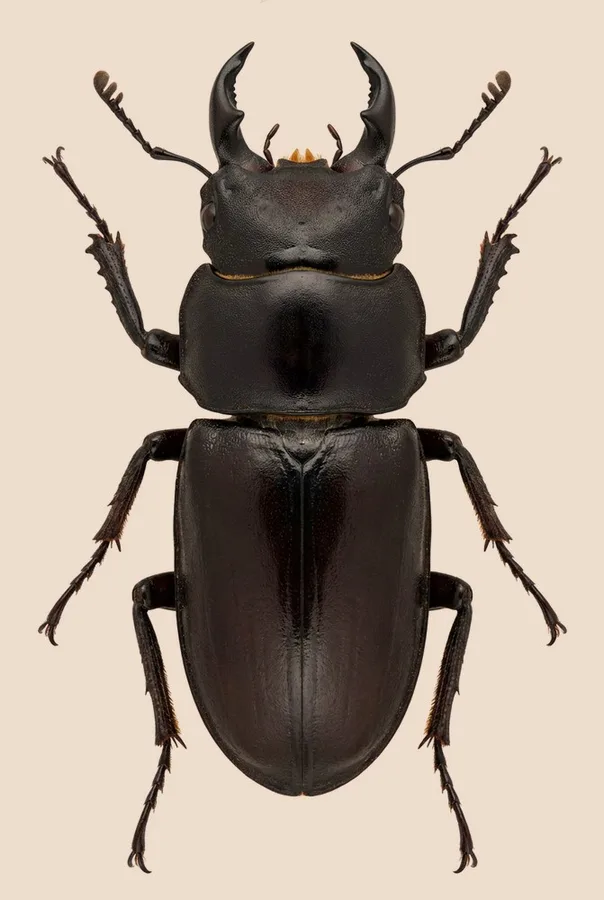
Little stag beetle
This flat, glossy black beetle can squeeze into narrow bark crevices to hide from danger and often turns up on tree-lined city streets, not just deep woodland.
| Where | Broadleaf forests, parks and street trees |
|---|---|
| Size | 17 to 60 mm body length |
| When | May to September |
The Little stag beetle has a glossy black to dark brown, notably flat body, with males carrying moderately enlarged mandibles bearing a single inner tooth; body length ranges from about 17 mm in small females to 54 mm in the largest males.
Adults are found on oak sap flows from around May into early autumn, in broadleaved forest, parks and even street trees, and some individuals survive the winter to live into a second year, while larvae develop inside rotting wood.
Traits
Habitat
Woodland
Colour
Black, Brown
Active
Day and night
To people
Harmless to people; a timid beetle that hides in bark crevices rather than defend itself against humans.
Activity through the year
Often confused with
Very similar in size, colour and jaw shape, and often confused with it, but separated by the inner tooth on the male mandible, which is thicker and more squared off rather than the more triangular tooth of the Little stag beetle.
Questions
Is the Little stag beetle dangerous to people?
Harmless to people; a timid beetle that hides in bark crevices rather than defend itself against humans.
When can you see the Little stag beetle?
The Little stag beetle can be seen from May to September, by day and at night.
Plate retouched from a photo by りなべる, CC BY 4.0, iNaturalist Licence
Report a mistake in this entry
Last updated 2026-09-27. Every entry is checked against published sources.