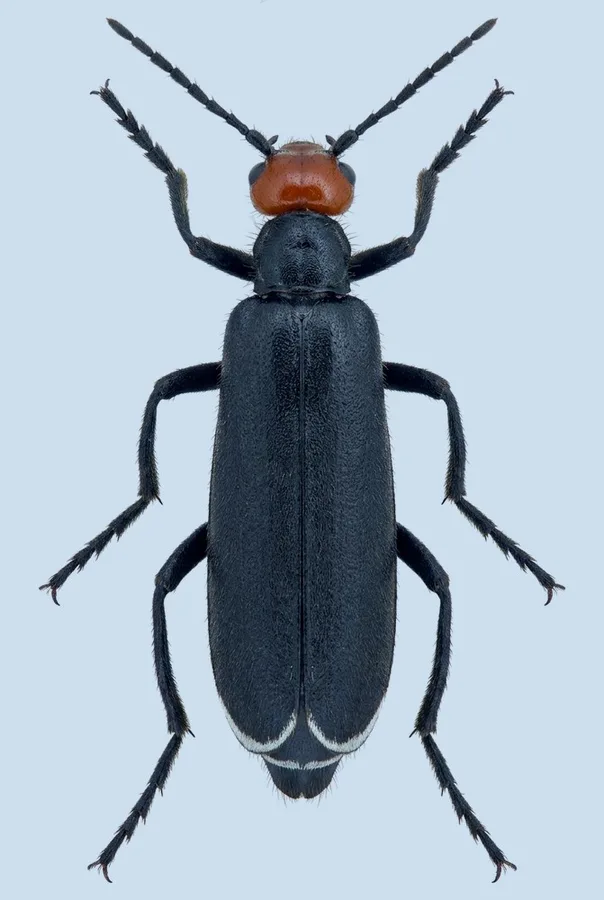
Red-headed blister beetle
This beetle's leg joints ooze a yellow fluid containing cantharidin, the same blistering compound long used in traditional Chinese medicine despite its toxicity.
| Where | Forests and fields across Asia |
|---|---|
| Size | 15 to 25 mm body length |
| When | April to September |
The Red-headed blister beetle is a slender black beetle with a contrasting orange-red head and a pale border along its wing cases. It is often seen resting in groups on low plants and ferns.
Females lay eggs in the soil, and the larvae hunt down grasshopper egg masses to feed on underground. Adults are most active through summer in forests and fields at low to mid elevation.
Traits
Habitat
Farmland
Colour
Black, Red, Grey
Active
Day
To people
Take care
Handling releases a yellow fluid that blisters skin; avoid touching with bare hands.
Activity through the year
Often confused with
The Banded blister beetle has broad orange bands across its black elytra, unlike the plain black elytra and red head of the Red-headed blister beetle.
Questions
Is the Red-headed blister beetle dangerous to people?
Take care. Handling releases a yellow fluid that blisters skin; avoid touching with bare hands.
When can you see the Red-headed blister beetle?
The Red-headed blister beetle can be seen from April to September, by day.
Plate retouched from a photo by ritagu, CC0, iNaturalist Licence
Report a mistake in this entry
Beetles›Blister beetles›Epicauta
Last updated 2026-09-27. Every entry is checked against published sources.