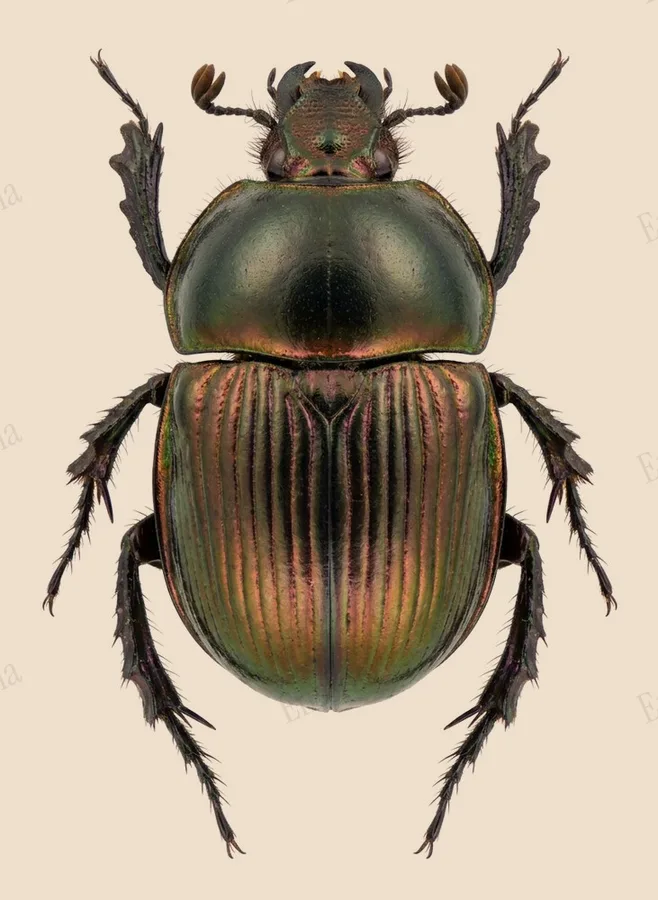
Japanese earth-boring dung beetle
This dung beetle's mirror-bright shell can be red, green or deep blue depending on where in Japan it lives.
| Where | Grassland and forest edges across Japan |
|---|---|
| Size | 15 to 24 mm body length |
| When | January and April to October |
This is a stout, oval dung beetle with a strong metallic sheen that varies by region, appearing red, green or blue depending on the population. The head and thorax are broad and the legs are built for digging.
Adults locate fresh droppings from deer and other grazing animals and bury portions of it in tunnels below, where the dung feeds their larvae. Because they remove waste from the surface, their numbers have declined along with the grazing land they depend on.
Traits
Habitat
Grassland
Colour
Metallic, Green, Red
Active
Day
To people
Harmless to handle, and considered beneficial for recycling dung and aerating soil.
Activity through the year
Often confused with
Phelotrupes laevistriatus is duller and more evenly dark purplish brown with a rounded head shield, while Phelotrupes auratus has a near-mirror gloss and a squarer, slightly pointed head shield.
Questions
Is the Japanese earth-boring dung beetle dangerous to people?
Harmless to handle, and considered beneficial for recycling dung and aerating soil.
When can you see the Japanese earth-boring dung beetle?
The Japanese earth-boring dung beetle can be seen from January and April to October, by day.
Plate retouched from a photo by Евгений Рыбальченко, CC BY 4.0, iNaturalist Licence
Report a mistake in this entry
Beetles›Dor beetles›Phelotrupes
Last updated 2026-09-27. Every entry is checked against published sources.