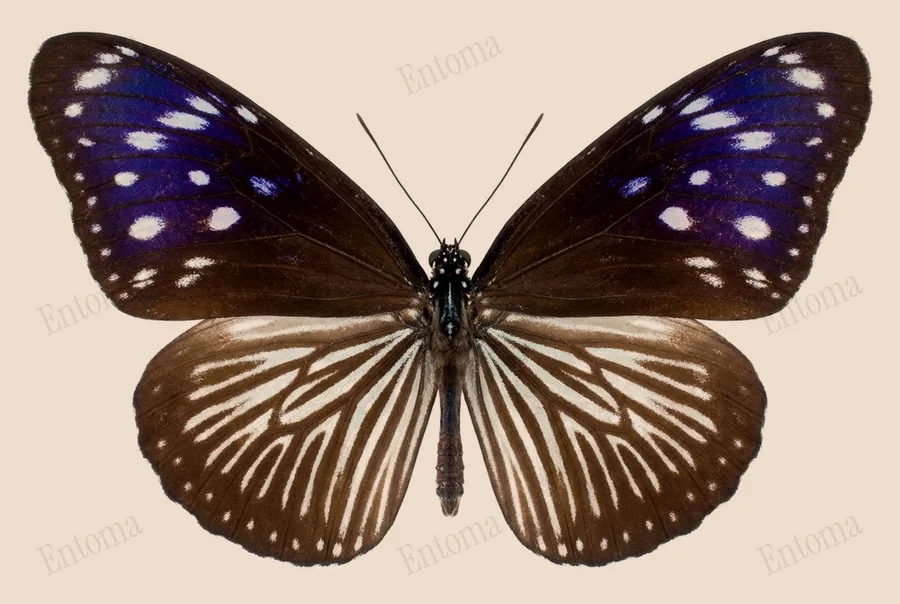
Striped blue crow
Male Striped blue crows flash brilliant blue across black wings, and their caterpillars store toxins from the poisonous host plants they eat as larvae.
| Where | Forest edges, parks and gardens |
|---|---|
| Size | 80 to 110 mm wingspan |
| When | March to November |
The Striped blue crow is a large, dark butterfly. Males show a brilliant blue gloss over black wings marked with curved rows of pale blue white spots, while females are plainer brown with larger, purer white spots and streaks in the same pattern.
Caterpillars feed on a range of plants including oleander and giant milkweed, both of which contain toxins that the caterpillars retain into adulthood, making the adult butterfly distasteful and mildly poisonous to predators that try to eat it. Adults fly through most of the year at forest edges, parks and gardens.
Traits
Habitat
Woodland
Colour
Black, Blue, White
Active
Day
To people
Mild
Safe to handle; adults are distasteful and mildly poisonous if eaten by predators.
Activity through the year
Often confused with
Is glossy black without the brilliant blue gloss of this species, and shows a small dark scent brand near the forewing margin rather than the curved rows of blue white spots.
Questions
Is the Striped blue crow dangerous to people?
Mild. Safe to handle; adults are distasteful and mildly poisonous if eaten by predators.
When can you see the Striped blue crow?
The Striped blue crow can be seen from March to November, by day.
Plate retouched from a museum specimen photo by Swiss Natural History Collections - SwissNatColl, CC BY 4.0, GBIF Licence
Report a mistake in this entry
Butterflies and moths›Brush-footed butterflies›Euploea
Last updated 2026-09-27. Every entry is checked against published sources.