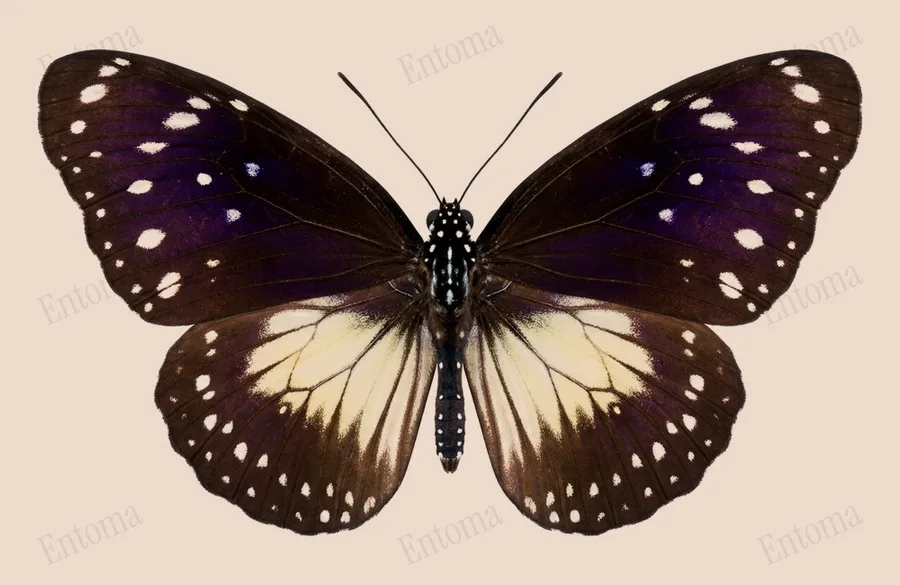
Purple crow butterfly
Despite its name, the Purple crow rests looking deep brown or black, and only flashes an iridescent purple sheen when sunlight catches its wings at the right angle.
| Where | Forest edges, gardens and valleys |
|---|---|
| Size | 40 to 80 mm wingspan |
| When | March to November |
Wings are deep brown to near black above and below, broken by small white and pale blue spots along the forewing margins, with an iridescent purple sheen visible only in direct sunlight.
Caterpillars feed on fig and other Moraceae plants rather than the milkweeds used by many related crow butterflies, and the population on Taiwan forms a distinct, seasonally migratory subspecies.
Traits
Habitat
Woodland
Colour
Brown, Black, Blue
Active
Day
To people
Mild
Slow flying and easy to approach; not documented to sting or bite, though it stores plant compounds that can be toxic if eaten.
Activity through the year
Often confused with
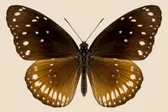
Larger at 85 to 95 mm wingspan, with males showing a velvety black scent brand near the rear edge of the forewing, a mark the smaller Purple crow lacks.
Questions
Is the Purple crow butterfly dangerous to people?
Mild. Slow flying and easy to approach; not documented to sting or bite, though it stores plant compounds that can be toxic if eaten.
When can you see the Purple crow butterfly?
The Purple crow butterfly can be seen from March to November, by day.
Plate retouched from a museum specimen photo by Swiss Natural History Collections - SwissNatColl, CC BY 4.0, GBIF Licence
Report a mistake in this entry
Butterflies and moths›Brush-footed butterflies›Euploea
Last updated 2026-09-27. Every entry is checked against published sources.